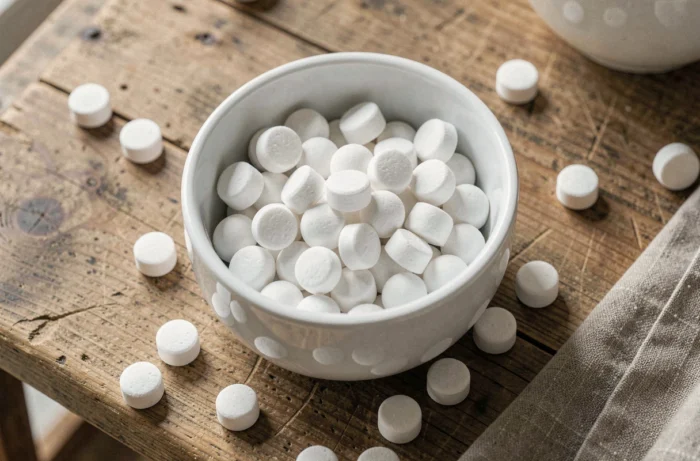
You may have childhood memories of it: that little white octagon with a slightly minty taste, which you bite into after a hearty meal. Vichy pastilles have been embedded in French culture for over a century. Their reputation as a “candy that helps with digestion” places them halfway between a confection and a grandmother’s remedy, and regular consumption is not trivial for everyone.
Sodium Bicarbonate and Digestion: A Double-Edged Mechanism
The active ingredient in Vichy pastilles is sodium bicarbonate extracted from the mineral waters of the spa. Upon contact with hydrochloric acid present in the stomach, it triggers a simple chemical reaction: the acid is neutralized, CO₂ is released, and the burning sensation subsides within minutes.
The relief is real, but temporary. And that’s where the problem begins.
After this quick neutralization, the stomach detects the sudden drop in acidity. It reacts by overproducing gastric acid, a phenomenon known as rebound effect. For someone prone to gastroesophageal reflux, this repeated use can perpetuate a vicious cycle: relief, acid rebound, new pastille, new rebound. Better understanding Vichy pastilles and their effects can help avoid this common trap.
The gastric distension caused by the released CO₂ poses another problem. This gas dilates the stomach and can worsen acid reflux in individuals whose lower esophageal sphincter is already weakened. For occasional digestive discomfort, a pastille can be helpful. For chronic reflux, it risks exacerbating it.

Vichy Pastilles and Sodium Intake: An Underestimated Risk
Sodium bicarbonate contains, by definition, sodium. Each pastille provides a modest amount when taken in isolation, but the cumulative consumption over a day can become significant. Have you ever noticed that people rarely just chew one?
For a healthy person, this additional intake goes unnoticed. The situation changes dramatically for the following profiles:
- People suffering from high blood pressure, for whom excess sodium promotes water retention and elevated blood pressure.
- Patients with heart or kidney failure, for whom sodium overload can cause edema and worsen the existing condition.
- Anyone following a low-sodium diet prescribed by a doctor, where every hidden source of sodium counts.
Online retailers selling these pastilles rarely mention this point. The presentation remains that of a traditional candy, not that of a product containing an active ingredient with real medical contraindications.
Sugar-Free Versions and Sweeteners: What the Label Doesn’t Clearly Say
Vichy pastilles are available in a sugar-free version, aimed at people monitoring their blood sugar or weight. These variants replace sugar with sweeteners like aspartame or sucralose.
The substitution is not neutral. Some publications, including Doctissimo, report a potential link between regular consumption of erythritol (a polyol used in some sugar-free products) and an increased cardiovascular risk. The data suggest a notable rise in the risk of heart attack and stroke among regular consumers.
Check the ingredient list on the packaging before assuming that a “sugar-free” version is automatically healthier. The type of sweetener used varies by batches and ranges. Some polyols also cause digestive issues (bloating, diarrhea) when consumed in quantity, a paradoxical effect for a product meant to aid digestion.
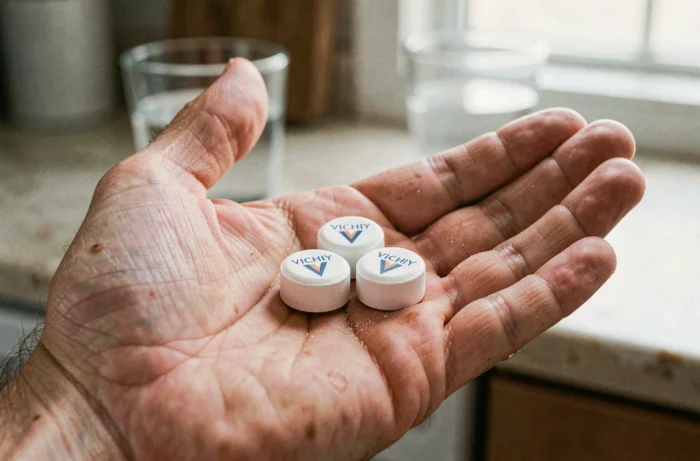
Vichy Pastilles: What is a Reasonable Daily Consumption?
There is no official dose set by a health authority for this candy. Vichy pastilles are not a medication in the regulatory sense, even if their main component (bicarbonate) is one in other galenic forms.
Some practical guidelines can help set a framework:
- Limit intake to a few pastilles per day, preferably after a meal and not on an empty stomach, to reduce the risk of acid rebound.
- Do not use the pastilles as a treatment for chronic reflux. If heartburn returns several times a week, a medical consultation is necessary.
- Inform your doctor about regular consumption of Vichy pastilles if you are on medication for hypertension or a kidney condition, as the additional sodium intake may interfere with treatment.
- Space the intake by at least two hours from other medications, as bicarbonate can alter the absorption of certain active ingredients.
These precautions may seem disproportionate for a candy sold in supermarkets. They are not. Sodium bicarbonate remains an active compound, regardless of the packaging it comes in.
Children and the Elderly: Two Groups to Monitor
In children, the renal capacity to eliminate sodium is more limited. A few occasional pastilles do not pose a problem, but daily consumption should be monitored. In the elderly, often on multiple medications and sometimes with early kidney failure, vigilance is even more justified.
Vichy pastilles remain a pleasant candy, linked to a region and real know-how. Their profile is not dangerous for a healthy person who chews two or three after a meal. The problem arises when consumption becomes habitual, daily, and involves an organism already weakened by a cardiovascular or kidney condition. The sodium bicarbonate they contain is an active ingredient, not just a flavoring.