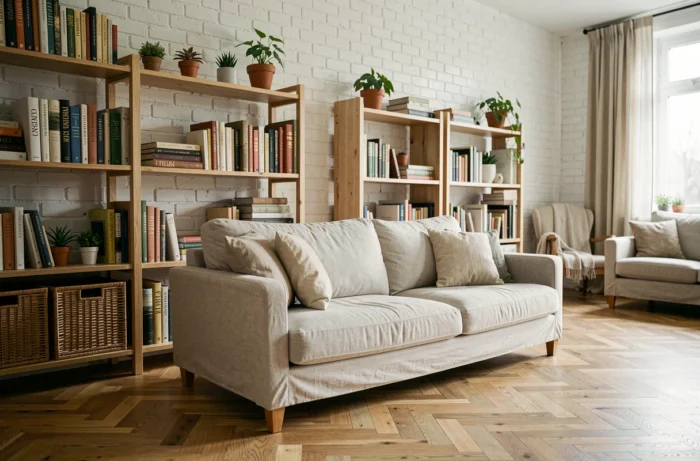
An organized home is not just about visible tidiness. The difference between a space that lasts over time and one that falls back into disorder within days lies in structural choices, not daily discipline. Here, we address the lesser-discussed levers in traditional guides, those that relate to the very design of spaces and how the brain interprets the domestic environment.
Cortisol profile and perception of beauty: what research changes for interior design
A study published in 2025 in the Journal of Environmental Psychology establishes that the relationship between clutter and well-being is mediated by the perception of beauty in the home. The more cluttered an interior is perceived to be, the lower the reported life satisfaction, and this link is partly explained by the fact that residents perceive their home as less beautiful.
Research highlighted in 2026 by El Periódico, published on the Sage Journals platform, specifies the physiological mechanism: a home described as cluttered is associated with an unfavorable cortisol profile. Women who describe their home in terms of accumulation and unfinished objects exhibit flatter daily cortisol curves, a marker linked to poorer health outcomes. In contrast, those who describe a “restorative” home show more pronounced curves, indicating better stress regulation.
We recommend starting from this observation to guide your design choices. Before multiplying storage furniture, the priority is to reduce the overall visual load of a room. This involves choosing closed surfaces rather than open ones, reducing the number of exposed objects, and maintaining a coherent color palette. Find home tips on Zenith Actu to delve deeper into these principles applied room by room.
A point often overlooked: slightly chaotic spaces can foster creative thinking. The goal is therefore not a clinical interior, but a balance between structural order and visual freedom.

Functional zoning of rooms: design before organizing
Organization fails when it is imposed on a poorly thought-out space. We observe that the majority of disorganized interiors suffer from a zoning issue, not a lack of boxes or shelves.
Defining micro-zones by use
Each living space serves multiple functions. A living room is for resting, reading, and sometimes working. A kitchen combines preparation, storage, and often quick meals. Assigning a specific physical zone to each use prevents the migration of objects from one end of the room to the other.
In practice, this means that the reading corner has its own storage within reach (a closed low unit, not a pile on the armrest). That the kitchen countertop is mentally divided between preparation and service areas, with utensils stored as close as possible to their point of use.
The principle of the short domestic circuit
An object used daily should never travel more than two steps between its storage place and its place of use. This simple principle eliminates most accumulations on horizontal surfaces. Shoes remain in the entryway if a closed unit is present. Mail is processed where it is opened, not on the living room table.
- Entryway: coat rack, closed shoe cabinet, and catch-all for keys and mail, nothing more.
- Kitchen: everyday utensils within arm’s reach of the stove, the rest in high or back storage.
- Bedroom: weekly clothes accessible without opening a secondary drawer, off-season items in separate storage.
- Bathroom: only products in use remain visible, stock goes in a closet outside the room.
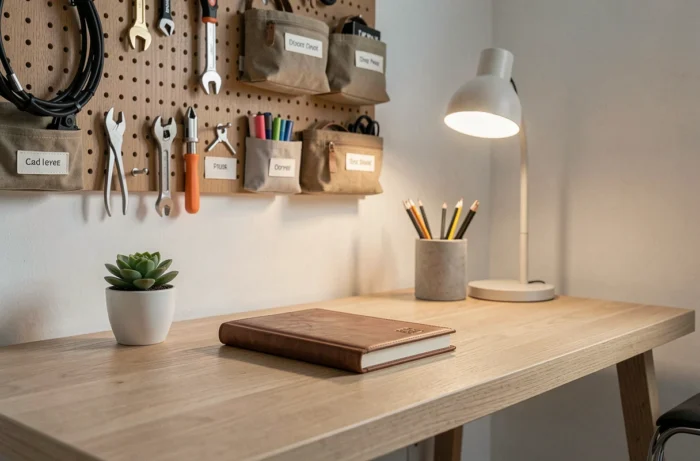
Custom furniture and storage: balancing investment and modularity
Standard storage furniture meets average dimensions. A series wardrobe offers shelves spaced 30 to 40 cm apart, leaving empty space above stacks of folded clothes and generating a feeling of clutter despite available space.
Custom solutions are only cost-effective in high-use areas: entryway, kitchen, and wardrobe. For the living room or bedroom, modular furniture allows for configuration adjustments without a permanent commitment. We recommend reserving the custom budget for constrained spaces (under sloped ceilings, narrow hallways, architectural niches) where no standard furniture works.
Criteria for choosing effective storage furniture
- Closed doors rather than open shelves in living areas: visual load decreases immediately, even if the content is the same.
- Depth suited to actual content: a too-deep unit encourages stacking and forgetting what’s at the back.
- Height utilized up to the ceiling: high storage absorbs off-season items and stock without encroaching on living space.
- Compartmentalized interior with removable dividers, to adapt to changing needs without changing the furniture.
Maintenance integrated into design: reducing friction in daily life
An enjoyable interior over time is not the one that is cleaned the best, but the one that gets dirty the least quickly and can be tidied up with minimal effort. This relates to choices of materials and design, not personal will.
Smooth floor coverings (large-format tiles, polished concrete) can be cleaned in one pass with a mop, whereas wide-jointed parquet accumulates dust. Compact material countertops without visible joints eliminate dirt retention areas. Every joint, groove, or textured surface adds maintenance time.
For decor, the same principle applies: fewer objects on horizontal surfaces mean fewer manipulations during each cleaning. A frame hung on the wall does not move. A knick-knack on a shelf does.
The organization of a home begins before purchasing the first storage bin. Easy-to-maintain materials, zoning by use, furniture sized to actual content, and reducing visual load form a coherent system. Each well-placed structural choice eliminates dozens of daily micro-decisions, and this is precisely what makes an interior sustainably pleasant.