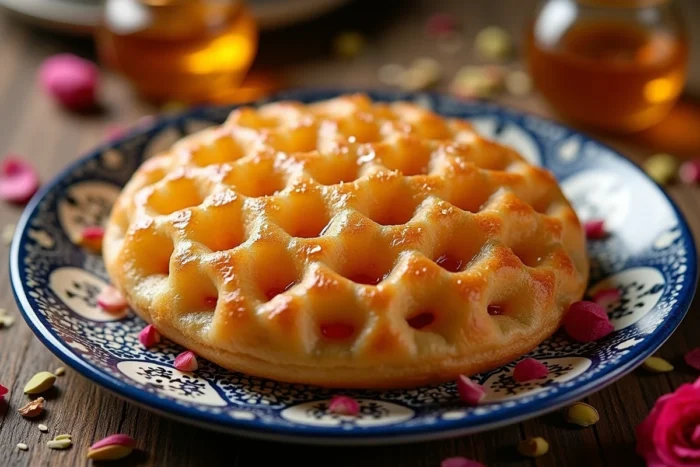
When you open a brioche dough and it sticks to your fingers without tearing, you know that the khaliya al nahl is on the right track. This Eastern pastry, shaped like a beehive and filled with cheese or cream and then drizzled with honey, requires few ingredients but precise execution.
Success depends less on the complexity of the recipe and more on three technical gestures that are often underestimated: kneading, shaping the honeycombs, and choosing the right honey for glazing.
Kneading the khaliya al nahl: the window test as a guide
Most recipes for Eastern brioche indicate a fixed kneading time. For khaliya al nahl, this time doesn’t mean much: it all depends on the kitchen temperature, the humidity of the flour, and the power of the mixer.
The real indicator is the window test. You take a piece of dough, gently stretch it between your fingers. If it forms a translucent membrane without breaking, the gluten network is ready. As long as the dough breaks cleanly, you continue to knead.
For the fat, the butter should be soft (not melted) and incorporated gradually. Adding it in one block cools the dough and prolongs the kneading. Cut it into small pieces and integrate them one by one, allowing each portion to blend into the mass before adding the next. For those looking for the khaliya al nahl recipe on Mademoiselle Caramel, the exact proportions are detailed there with the appropriate resting times.
The first rise usually lasts a good hour at room temperature. Cover the bowl with a damp cloth rather than plastic wrap: the dough breathes better and develops more flavor.
Shaping into honeycombs: filling and arrangement in the mold
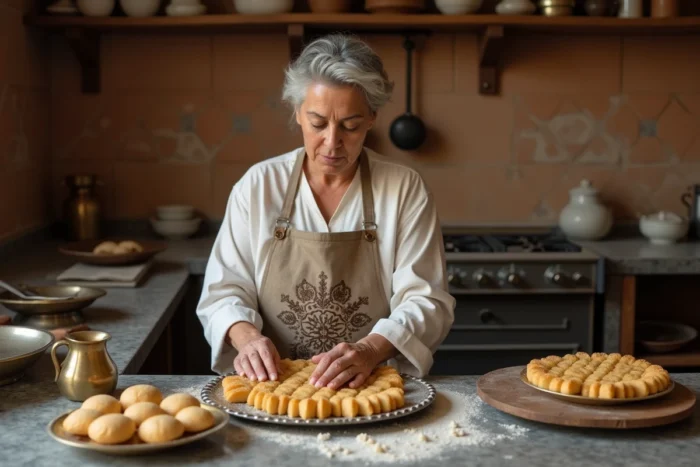
This is the step that gives khaliya al nahl its characteristic appearance. Each ball of dough is flattened in the palm, filled, then closed and placed tightly against its neighbors in a round or rectangular mold.
Cheese or cream filling
The cheese version traditionally uses unsalted fresh cheese, such as desalted akkawi or mozzarella. A teaspoon is placed in the center of each dough disc. The sweet version replaces the cheese with a thick pastry cream flavored with orange blossom.
Opinions vary on this point: some prefer a cream-cheese mixture to achieve both stretchiness and sweetness. This idea works as long as you don’t overfill, otherwise the filling escapes during baking and sticks to the bottom of the mold.
Arrangement in the mold
Generously butter the mold. Each stuffed ball is placed seam side down, and they are pressed against each other without crushing. A space of about half a centimeter between each ball is sufficient: they will puff up during the second rise and merge to form the honeycomb structure.
This second rise in the mold is short, about thirty minutes. You know it’s done when the balls touch and the surface of the mold is completely covered without any visible gaps.
- Brush the top with a mixture of egg yolk and milk before baking to achieve a golden crust
- Sprinkle with nigella seeds or white sesame according to the desired tradition
- Bake at moderate heat so that the center cooks without the top burning
Glazing honey for khaliya al nahl: what the new regulations change
The honey is the final element, the one that transforms a simple filled brioche into an Eastern pastry. It is poured warm over the honeycombs as soon as it comes out of the oven, while the dough is still warm and absorbent.
The choice of honey matters. An orange blossom honey adds a floral note that complements the cream filling. A more robust wildflower honey is better suited for the cheese version, where the sweet-salty contrast becomes more pronounced.
Since June 14, 2026, jars of honey sold in the European Union from blends must display the complete list of countries of origin with the exact percentage of each source, ranked from most to least represented, with a tolerance of error of 5%. In practice, this means that you can now read on the label whether an “orange blossom” honey predominantly comes from a specific terroir or if it is a dispersed blend.
For khaliya al nahl, this transparency is a real gain. A honey with an identifiable dominant origin offers a more readable aromatic profile than an opaque blend labeled “EU and non-EU”. You can adapt the glazing to the type of filling chosen with informed knowledge.
Cooking and serving: mistakes that ruin the texture
Khaliya al nahl is baked at moderate temperature. An oven that is too hot browns the top in a few minutes while the inside remains raw and doughy. The goal is a gradual and even coloration.
Two common mistakes are:
- Pouring cold honey over a warm brioche: it does not penetrate, stays on the surface, and makes the crust sticky without soaking the crumb
- Unmolding too quickly: the melted filling spills out and the honeycombs tear. Wait about ten minutes before turning the mold onto a serving platter
- Reheating in the microwave the next day: the dough becomes rubbery. A quick pass in the oven at low temperature restores crispness without drying it out
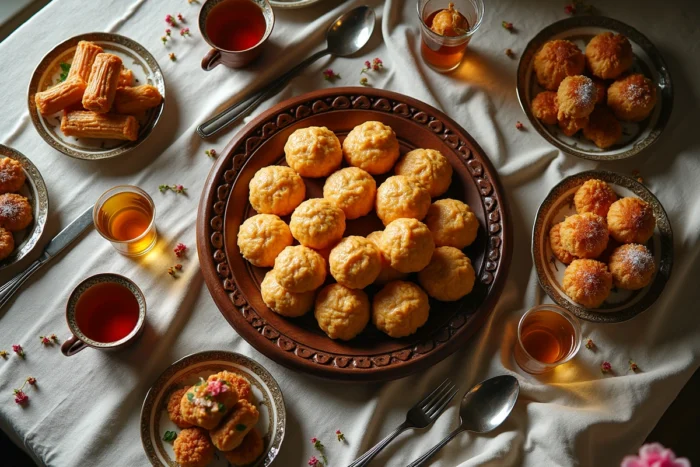
Khaliya al nahl is ideally enjoyed warm, when the cheese is still stretchy or the cream remains melting under the golden crust. Accompanied by mint tea or Arabic coffee, it easily replaces more complex Eastern pastries for a generous snack.
The next time the dough sticks to your fingers without breaking, it means that the gluten network has reached the right elasticity and the hive will take shape. The rest is well-chosen honey and a patient oven.