
Free thermometer apps on iPhone all rely on the same source: weather data from remote stations, not a sensor embedded in the phone. No iPhone sold to date includes a thermal probe designed to measure ambient or body temperature. The internal thermal sensor is used exclusively for battery and processor management.
Internal thermal sensor of the iPhone: what it actually measures
The temperature sensor present in every iPhone monitors the heat emitted by the SoC (System on Chip) and the lithium-ion battery. Its role is to trigger thermal throttling when the internal temperature exceeds a critical threshold or to interrupt fast charging to protect the cells. This sensor is not exposed to third-party developers via iOS APIs.
Apple does not provide any public interface (CoreMotion, HealthKit, WeatherKit) to read the temperature of the casing or the immediate environment. Here we find the point of confusion: several apps display a figure in degrees Celsius and imply that it comes from the phone, while it is retrieved via a network request to a weather service.
To delve deeper into this topic, we recommend consulting the detailed analyses on the free thermometer on iPhone with Info Geeks, which breaks down the real mechanisms behind these applications.

Free thermometer app on iPhone: three often confused uses
The majority of users confuse three distinct functions when looking for a thermometer app. This confusion is perpetuated by the marketing of publishers on the App Store.
- Local weather: the app queries a service like OpenWeatherMap or WeatherKit and displays the temperature recorded by the nearest weather station, sometimes located several kilometers away. The discrepancy with the reality of your street can reach several degrees, especially in dense urban areas where heat islands skew the readings.
- Internal temperature of the phone: some apps attempt to deduce the ambient heat from the temperature of the processor. The result is systematically biased by the self-heating of the device, which generates its own heat as soon as it operates.
- Actual temperature of a room: this measurement requires an external physical sensor (connected probe, home weather station) linked to the iPhone via Bluetooth or Wi-Fi. No free app without an accessory can provide this data.
A prolonged test of the native weather app on the iPhone, documented over several months, showed significant discrepancies compared to a reference home station. The app remains acceptable for tracking a general trend, but not for reliable measurement at the scale of a room.
Reliability of iOS thermometer apps: why user reviews differ
On the App Store, applications like @Thermomètre display high ratings despite the absence of a dedicated sensor. The explanation lies in a misunderstanding of what the user is evaluating: most rate the quality of the interface, not the accuracy of the measurement.
When a user compares the displayed figure to the Météo France forecast and finds consistency, they validate the app. Logical: both draw from similar weather sources. The confirmation loop is closed, but no local measurement has been made.
Negative reviews almost always point to the same problem: the gap between the displayed temperature and the one felt inside the home. This gap is not a bug. The app displays the estimated outside temperature, not that of your living room. The lack of clear distinction in the interface deliberately maintains ambiguity.
The case of body temperature apps
Some free apps claim to measure fever using the iPhone’s camera or flash. No standard optical sensor allows for an infrared measurement of skin temperature with medical precision. These applications are simulators, not measuring instruments. We observe that the App Store continues to list them, sometimes with ambiguous mentions of their health purpose.
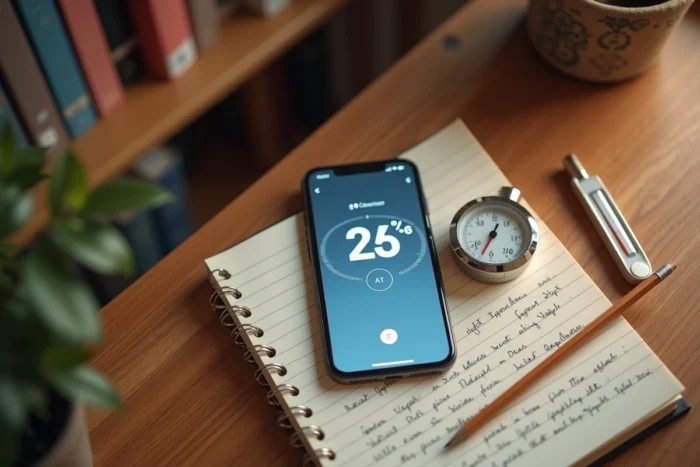
External accessories and concrete alternatives for measuring temperature on iPhone
To obtain a real measurement of ambient temperature via an iPhone, an external connected accessory remains the only reliable method. Home weather stations communicate via Bluetooth or Wi-Fi with a dedicated app and include a calibrated thermal probe.
HomeKit-compatible connected probes transmit their readings directly to Apple’s Home app. This protocol ensures real-time reading and usable history, without relying on a distant weather service.
For body temperature, only connected medical thermometers (infrared ear or forehead) paired via Bluetooth offer acceptable accuracy. The data then passes through HealthKit with a timestamp and tracking over time.
- Weather station with indoor/outdoor probe: reliable ambient measurement, history in the companion app
- HomeKit sensor (like Eve Room): native iOS integration, possible automations
- Bluetooth medical thermometer: certified body measurement, export to HealthKit
The cost of these accessories remains modest compared to the illusion of a free app that measures nothing. An entry-level connected probe costs significantly less than a premium subscription to a weather app, while providing genuinely local data.
Measuring temperature with an iPhone without an external accessory amounts to reading the national weather and applying it to your living room. The free app does not turn the phone into a thermometer, it dresses a distant data point in a reassuring interface. For a local measurement, whether ambient or body, a physical sensor remains the necessary step.