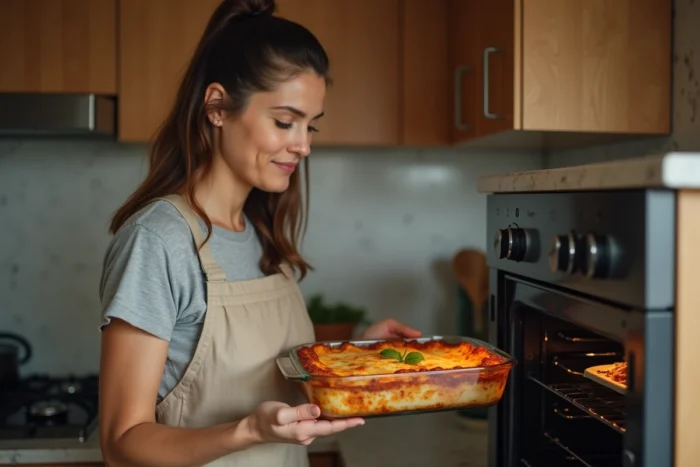
Reheated lasagna presents a specific problem: its layered structure (pasta, sauce, béchamel, cheese) means that each component reacts differently to heat. The top dries out before the center is hot, the béchamel sets, and the pasta absorbs the residual moisture. Reheating already cooked lasagna without drying it out requires understanding this thermal imbalance to respond with the right method and timing.
Internal temperature at 74 °C: the criterion that most recipes overlook
Reheating guides often talk about duration and oven temperature. They rarely mention the target internal temperature of 74 °C at the center of the dish. This threshold corresponds to food safety recommendations for reheated cooked dishes, notably relayed by the USDA.
For lasagna, this benchmark changes the logic: instead of setting an arbitrary timing, we adjust the cooking based on the measured result at the heart of the dish. A probe kitchen thermometer, inserted into the center of the thickest portion, provides a reliable reading. As long as the center does not reach 74 °C, reheating is not finished, regardless of the appearance of the top.
This point is especially useful for lasagna stored in the refrigerator since the day before. A thick, cold dish takes time to heat up evenly. Taking the lasagna out of the refrigerator about twenty minutes before baking helps reduce the gap between the surface and the center, thus limiting the time the top layer is exposed to heat.
Those who wish to reheat cooked lasagna with Toutes Les Recettes will find a complementary protocol detailing the times by type of oven.
Reheating in the oven: the distinction between soft and gratin
The oven remains the most reliable method for reheating whole portions of lasagna. The difficulty lies in the fact that two objectives oppose each other: keeping the inside soft while achieving a gratin surface.
The solution lies in a two-phase reheating process. The first phase, covered, protects the dish from drying out. The second phase, uncovered, restores the crispiness of the cheese.
Covered phase: moderate temperature and humidity
Preheating the oven to a moderate temperature (around 160-170 °C) and covering the dish with aluminum foil allows the heat to penetrate gradually without evaporating the water contained in the sauces. Adding one or two tablespoons of water or tomato sauce on top before covering enhances this protection. The water turns into steam under the aluminum and maintains a humid microclimate.
Uncovered phase: temperature rise for gratin
A few minutes before the end of reheating, remove the aluminum and raise the oven temperature to about 180 °C. This brief increase is enough to brown the cheese without drying out the lower layers. The uncovered phase should not exceed a few minutes, just enough time for the surface to take on color.
This two-step approach is longer than reheating at a high temperature from the start, but it preserves the texture of the pasta and the fluidity of the béchamel.
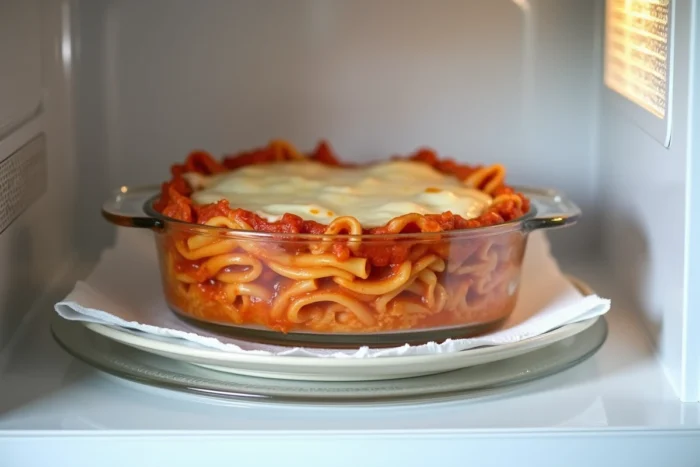
Reheating an individual portion of lasagna in the microwave
The microwave has a bad reputation for lasagna, and for a simple technical reason: microwaves heat the water contained in food. In a layered dish, the moist areas (sauce) heat quickly, while the drier areas (pasta, cheese) remain lukewarm or become rubbery.
To limit this imbalance, two adjustments make a real difference:
- Reduce the microwave power to about 50-60% and extend the reheating time. A lower power allows heat to diffuse between the layers instead of overheating the moist spots.
- Place a glass of water next to the plate in the microwave. The water absorbs some of the energy and slows down evaporation in the dish, which limits the drying out of the pasta on the surface.
- Cover the plate with a microwave cover or an inverted plate. The lid traps steam and redistributes it over the top of the lasagna.
The microwave will not replicate the gratin of the oven. However, for a single portion reheated in a few minutes, this method yields a decent result if the power is reduced.
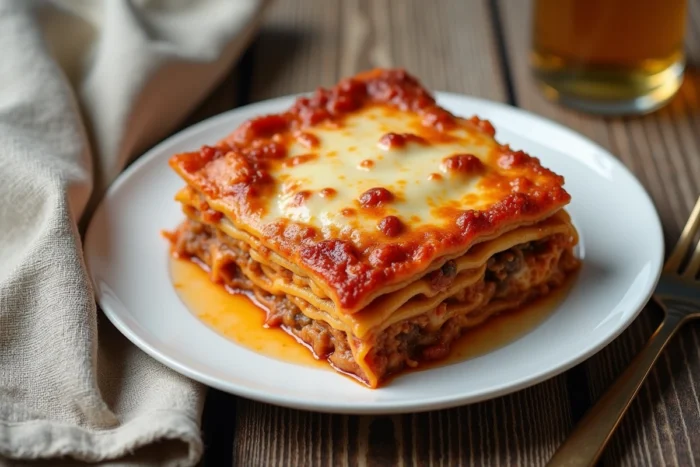
Reheating lasagna in a skillet: an unknown option for cut portions
The skillet works well for one or two already cut portions. It offers an advantage that neither the oven nor the microwave provides: a crispy bottom that replaces the gratin on top.
The technique requires a non-stick or cast iron skillet, a drizzle of olive oil, and a lid. Place the portion of lasagna in the cold skillet, add a tablespoon of water next to it (not on top), cover, and heat on low. The steam generated by the water warms the top while the bottom caramelizes slowly against the skillet.
The result is a lasagna with a golden base and a melting interior. Feedback varies on the time needed: it depends on the thickness of the portion and the conductivity of the skillet. Regularly checking by lifting the portion with a spatula remains the best indicator.
What happens before reheating: storage and preparation
Reheating actually begins when the lasagna cools after the first cooking. Two factors directly influence the result the next day:
- A plastic wrap placed directly in contact with the surface (and not over the dish) prevents the formation of a dry crust overnight in the refrigerator. The contact wrap limits surface evaporation much better than a lid that leaves an air space.
- Cutting portions before refrigerating allows for more even reheating. An individual portion heats up faster and more uniformly than a whole dish.
- If the lasagna is frozen, defrost it in the refrigerator the night before rather than at room temperature. The direct freezer-to-oven transition significantly extends reheating time and increases the risk of surface drying.
The quality of reheating depends as much on these prior actions as on the chosen method. A well-protected and properly tempered dish before being baked is more forgiving of temperature or duration approximations.