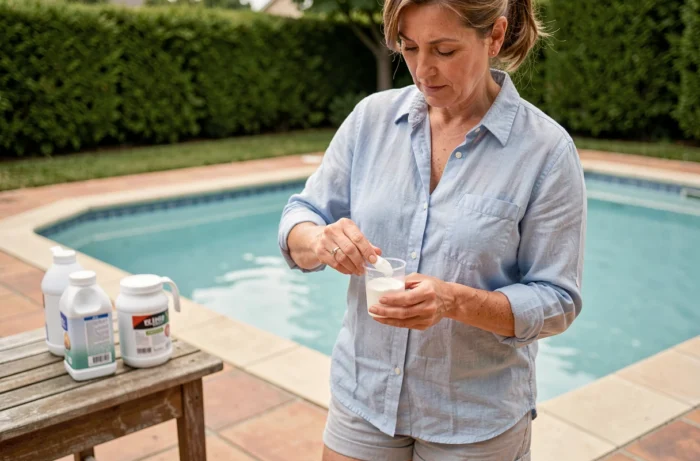
When the pH of a pool drops below 7.2 after heavy rain or intensive use, people often look for a quick solution in the garage stock. Sodium percarbonate, commonly used for laundry or cleaning, seems like a logical candidate: it is alkaline, sold in supermarkets, and perceived as “natural.” In practice, its use to correct the pH of a pool requires precautions that most guides do not detail.
Chemical Decomposition of Percarbonate and Real Effect on pH
Sodium percarbonate is not a treatment product designed for pools. When it dissolves, it decomposes into sodium carbonate and hydrogen peroxide. It is this dual action that creates both confusion and interest.
Sodium carbonate (soda ash) is a powerful alkalizing agent, used under the commercial name “pH+” by pool product manufacturers. It raises the pH, sometimes abruptly. Hydrogen peroxide, on the other hand, acts as an oxidizer: it destroys certain organic materials in the water but does not have a stabilizing role on the pH.
When using sodium percarbonate in the pool, you are therefore simultaneously injecting a pH corrector and an oxidizer, without controlling the actual proportion of each once diluted. This is where the dosing becomes tricky compared to a pure pH+ product.

Sodium Percarbonate versus pH+ and Sodium Bicarbonate: Which Product to Choose
Three alkalizing products frequently come up in discussions among pool owners. Their uses are not interchangeable.
| Product | Active Component | Main Action | Dosing Precision |
|---|---|---|---|
| pH+ (pure sodium carbonate) | Sodium carbonate | Raises pH quickly | High (manufacturer charts) |
| Sodium bicarbonate | Sodium bicarbonate | Raises TAC and stabilizes pH | Good (progressive action) |
| Sodium percarbonate | Sodium carbonate + hydrogen peroxide | Raises pH + oxidation | Low (variable ratio) |
Sodium bicarbonate acts on TAC (total alkalinity) before influencing pH. Recent technical guides emphasize one point: TAC must be checked before any pH correction. A TAC that is too low makes the pH unstable, and no amount of percarbonate will solve this underlying issue.
Percarbonate, however, does not offer reliable dosing. Pool product manufacturers calibrate their instructions based on pure formulations. With commercial percarbonate, the concentration of released sodium carbonate depends on the quality of the product, its storage duration, and the water temperature.
Field Protocol for Using Percarbonate in a Pool
If you decide nonetheless to use sodium percarbonate to raise a slightly low pH, a few field rules limit the risks.
- Test the pH and TAC before any intervention. If TAC is too low, correct it first with sodium bicarbonate, not with percarbonate
- Dilute the percarbonate in a bucket of warm water before pouring it into the pool, never directly in powder form into the water
- Pour the diluted solution in front of a return jet, with filtration running, to ensure even distribution
- Limit the correction to a small amount per intervention and do not exceed 0.3 to 0.5 pH points per day
- Retest the pH at least four hours after addition, then adjust if necessary the next day
The temptation to correct everything in one dose is the classic trap. An overdose of percarbonate raises the pH well above 7.6 and releases a quantity of hydrogen peroxide that can disrupt chlorine treatment for several hours.
Handling Precautions Not to Be Neglected
Sodium percarbonate releases an irritating alkaline solution upon contact with water. Reports vary on this point, but recent medical sources indicate risks of eye, skin, and respiratory irritation during handling.
Two non-negotiable rules: wear gloves and protective goggles, and never mix percarbonate with bleach or an acid. The chemical reaction produces dangerous gas emissions.
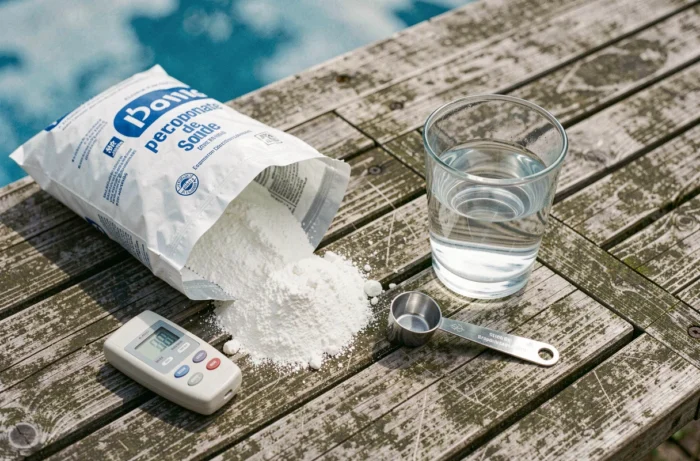
Why Percarbonate Remains a Stopgap and Not a Pool Treatment Method
Percarbonate can be used for a one-time correction of a slightly acidic pH, typically after a storm or rainwater addition. However, making it a regular maintenance product for the pool poses several concrete problems.
The hydrogen peroxide released interferes with chlorine. In a chlorine-treated pool (the vast majority of residential pools), the regular addition of percarbonate consumes some of the free chlorine, which necessitates overdosing the disinfectant. This leads to a cycle of corrections that costs more than a simple calibrated pH+ container.
Sodium bicarbonate remains the best ally for sustainably stabilizing pH, because it acts on the alkaline buffer of the water. Pure pH+ (sodium carbonate) is suitable for rapid and one-time raises. Percarbonate falls somewhere in between, without excelling in either role.
For a pool whose pH regularly drops, the priority is not the choice of the correcting product but the identification of the cause: a TAC that is too low, acidic fill water, or an unbalanced chlorine treatment that acidifies the pool week after week. Correcting TAC with sodium bicarbonate, then adjusting pH with a dedicated product, yields much more stable results than an approach using percarbonate.