
The choice of an electric trimmer hinges on technical details that the product sheet does not always highlight. Wire diameter, head type, motor torque, and battery compatibility determine both the cutting quality and the durability of the device.
Motor torque and wire diameter: the two parameters that determine actual cutting
The power displayed in watts (corded) or volts (battery) is not enough to evaluate a trimmer. It is the motor torque that defines the ability to cut through dense grasses without the rotation speed collapsing. A brushless motor maintains stable torque even when the wire encounters resistance, whereas a brushed motor loses speed as the grass thickens.
The diameter of the cutting wire directly interacts with this torque. A wire that is too thin breaks on tough grasses, while a wire that is too thick puts excessive strain on the motor. We recommend always checking the range of accepted diameters for the head and cross-referencing it with the motor power.
On battery models, the nominal voltage (18 V or 36 V) gives an indication of the available torque, but the determining factor remains the amp-hour rating. A high-capacity battery maintains the rotation speed longer, preventing clean cuts at the beginning of a session and ragged cuts at the end of autonomy.
Several comparisons available on taille-bordure-warrior.com detail these performance differences between corded and cordless models, with torque measurements in real conditions.
Legal risk of noise in residential areas: a neglected selection criterion
Classic buying guides mention sound comfort as an advantage of electric models over gas-powered ones. The issue goes further. Article R1336-5 of the Public Health Code qualifies noise as excessive as soon as the sound emergence exceeds 5 dB(A) during the day compared to the ambient noise.
An electric trimmer advertised as silent by the manufacturer may still exceed this threshold during repetitive or prolonged use. In a residential area or condominium, a neighbor can win a case even if an absolute decibel threshold is not crossed: it is the difference from the background noise that matters.
No national time frame regulates gardening work during the day. Each municipality sets its own time slots for noisy devices, and municipal decrees have been tightening in recent years. Checking the authorized hours in your municipality before investing helps avoid neighborhood conflicts as well as fines.
Cutting head and wire feeding system: the precision mechanics that make the difference
The cutting head is the most stressed component and the one that generates the most frustration during use. Three systems coexist:
- Manual feed (bump feed): you hit the head on the ground to release wire. Reliable but interrupts work, and the length of wire released varies.
- Automatic feed: the wire unwinds continuously according to the rotation speed. Smoother, but some models overconsume wire, especially on uneven terrain.
- Semi-automatic feed: an internal mechanism adjusts the wire output to the load. This is the system that offers the best compromise between cutting regularity and wire economy.
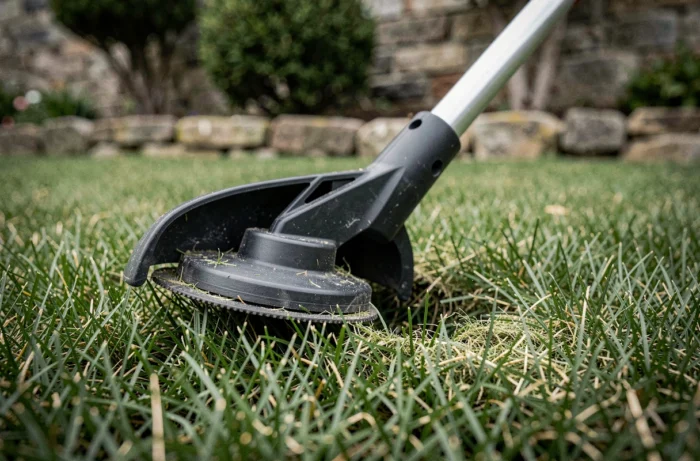
The shape of the wire also plays an underestimated technical role. A round profile glides over stems, while a square or star profile cuts them more cleanly. For finishing along flower beds and paths, a serrated profile wire provides a visibly cleaner result than a round wire of the same diameter.
Tiltable or adjustable head: two distinct functions
An adjustable head pivots horizontally to switch from edging mode to border trimming mode (vertical cutting along a path). A tiltable head tilts along the axis to reach under hedges or slopes. The two functions do not replace each other. A model that combines both offers real versatility in a garden with varied areas.
Ergonomics and weight: what prolonged work reveals
The gross weight tells only part of the story. The mass distribution between the head and the rear handle determines comfort during lateral passes. A device with a center of gravity that is too low tires the wrist in a few minutes, even if it weighs only a few kilograms.
The adjustable auxiliary handle in height and angle is a quality marker on mid-range models. It allows adapting the posture to the user’s height and the type of cut (horizontal, vertical, under obstacles). Entry-level models fix this handle in a single position, which constrains movement and degrades the precision of finishes.
- The shoulder harness, often sold as an option, relieves the back during sessions longer than twenty minutes and stabilizes the swing amplitude.
- A telescopic handle avoids bending for low edges but adds weight and slight mechanical play.
- The ground clearance of the protective cover conditions the cutting distance relative to hard surfaces (paving, low wall). A cover that is too low scrapes, while a cover that is too high leaves grass at the edge.
Battery compatibility and brand ecosystem: a structuring choice
Major gardening tool brands now offer shared battery platforms across multiple tools. Investing in a trimmer without checking compatibility with a lawnmower, blower, or hedge trimmer already owned leads to unnecessary multiplication of chargers and battery formats.
Battery compatibility transforms the purchase of a trimmer into an ecosystem choice. A slightly less powerful model but compatible with batteries already in stock may prove more rational than a superior device on paper but isolated in its own format.
Before comparing technical sheets, we recommend listing the gardening tools already owned and identifying the corresponding battery platform. This preliminary sorting reduces options and simplifies the final decision on the suitable trimmer model for a well-maintained garden over time.