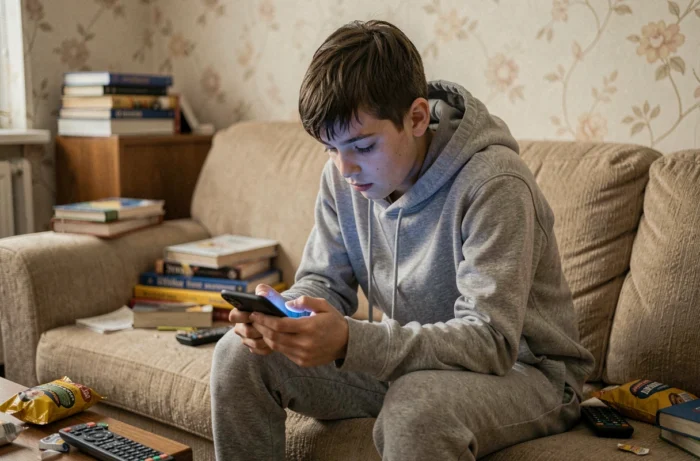
The dependence on screens among adolescents is not just about excessive time spent on a smartphone. In consultations, we observe clinical patterns where social withdrawal, sleep disturbances, and academic failure gradually set in, driven by dopaminergic reinforcement mechanisms that platforms exploit by design. Supporting an adolescent in this situation requires going beyond purely restrictive approaches to address neurobiological, familial, and environmental levers.
Attention Capture Mechanisms and Addictive Design of Platforms
Digital services aimed at young people use calibrated feedback loops: push notifications, infinite scrolling, variable rewards. These mechanisms replicate the pattern of operant conditioning, where the uncertainty of the reward maintains compulsive checking behavior.
The plan led by the High Commissioner for Children, Sarah El Haïry, introduces the Child Safe by Design doctrine, which aims to make the protection of minors a standard in the design of digital services. Specifically, this plan provides for protective parameters activated by default, a reduction of addiction mechanisms integrated into interfaces, and less exposure to problematic content.
The project includes a Challenge-score comparable to the Nutri-Score, intended to make the impact of a platform on the health and development of minors clear. For families, this tool would be a game changer: instead of having to audit each application, parents would have a synthetic indicator to guide their choices. We recommend following the progress of this initiative, as it conditions the real margins of maneuver for families in the face of addictive design.
Several families seeking to structure their approach find advice on Maman Anonyme to establish an appropriate framework for each age group.

Technical Settings for Adolescent Accounts: The Important Adjustments
The attempt to legally ban social media for minors has faced legal obstacles. Protection therefore relies even more on educational support and account settings than on an unenforceable blanket ban.
We recommend treating the settings as a shared educational act, done with the adolescent and not without their knowledge. Three technical adjustments deserve particular attention:
- Activate native screen time tracking (iOS or Android) and schedule a joint weekly review. The goal is not to monitor, but to make visible a usage that the adolescent almost systematically underestimates.
- Disable push notifications for all social media applications. This single action significantly reduces attention interruptions and breaks the compulsive checking loop.
- Set up an automatic night mode that cuts access to recreational applications at least one hour before bedtime. Blue light and late cognitive stimulation disrupt melatonin secretion, with measurable effects on sleep quality.
The settings do not replace dialogue, but they change the architecture of choices for the adolescent. Without these technical safeguards, sheer willpower is insufficient against interfaces designed to increase engagement.
Restructuring Family Daily Life Around High Social Density Activities
An adolescent does not disengage from a screen to face emptiness. Reducing screen time only has a lasting effect if it is accompanied by an active reconfiguration of daily life. Substitute activities must offer a level of social and emotional stimulation comparable to that provided by online games or social media.
Collective sports practices, theater, group music, or shared manual projects within the family fulfill this function. What matters is not the nature of the activity but its ability to generate face-to-face interactions and a sense of competence. An adolescent who finds a source of social gratification off-screen spontaneously reduces their digital usage.

We observe that families that establish screen-free sanctified moments (meals, trips, the first hour of the weekend) achieve better results than those that only set hourly quotas. The quota creates a constant negotiation, while the ritual creates a norm.
When to Consult a Specialist for Screen Addiction in Adolescents
Not all excessive usage falls under addiction. We distinguish problematic use, which yields to a restructured family framework, from established dependence, which requires specialized care. Several warning signs justify consulting:
- The adolescent exhibits intense emotional distress (irritability, aggression, crying) when access to screens is removed, even temporarily.
- Academic disengagement worsens despite the establishment of a structured family framework for several weeks.
- Social isolation becomes generalized: the adolescent refuses outings, activities, and interactions outside the digital world.
- Chronic sleep disturbances persist despite cutting off screens in the evening.
The care pathway begins with the primary care physician, who refers to a specialized addiction center or a therapist trained in digital issues. Dedicated hospital units for screen addiction in adolescents now exist in several French cities.
Care generally combines work on comorbidities (social anxiety, depression, attention disorders) and family support. Screen addiction often masks prior suffering that the digital world compensates for. Treating only the symptom without exploring the cause exposes individuals to rapid relapses.
Supporting an adolescent dependent on screens simultaneously involves technical settings, restructuring family daily life, and, when warning signs persist, consulting a trained health professional. Ongoing regulatory developments, particularly the Child Safe by Design doctrine, could alleviate some of the burden currently placed on families, provided that platforms effectively apply these design standards.