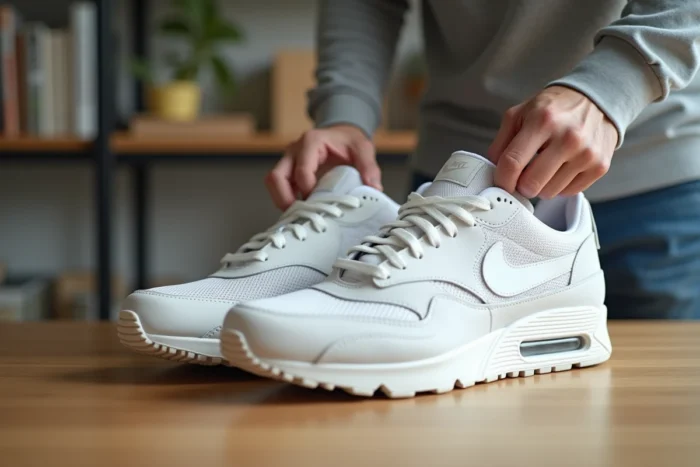
Checking a Nike serial number on a pair purchased online or on the secondary market remains a common reflex to spot counterfeits. However, this verification alone is no longer sufficient. Counterfeiters now obtain real product codes from authentic pairs and then reproduce them on fakes. Understanding what the label of a Nike shoe actually contains, and especially what it does not guarantee, lays the foundation for reliable authentication.
Structure of a Nike label: what each line encodes
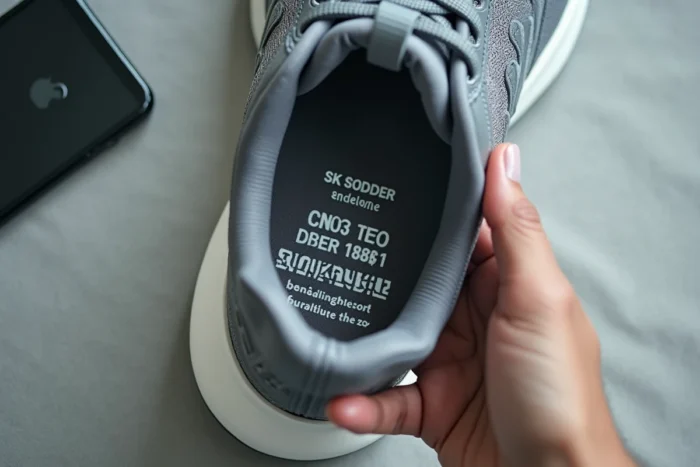
The inner label of a Nike shoe, usually sewn on the tongue or inside the collar, contains several blocks of data. Each has a specific function, and counterfeiters do not master them all with the same rigor.
| Element | Expected format | What it indicates | Anti-counterfeiting reliability |
|---|---|---|---|
| SKU code (style code) | 6 digits – 3 digits/letters (e.g., 554724-013) | Model + colorway | Low (copied by counterfeiters) |
| UPC/EAN barcode | 12 or 13 digits | Scannable product identifier | Medium (verifiable via GEPIR databases) |
| Size / country of manufacture | US, UK, EUR, CM + country (Vietnam, China, Indonesia) | Shoe size and factory of origin | Low alone |
| Manufacturing date | MM/DD/YYYY or similar format | Production period | Medium (frequent inconsistencies on fakes) |
The SKU code remains the first element checked by buyers. A quick search on the Nike website or a search engine can confirm that it corresponds to the correct model and colorway. You will also find tips for authenticating a Nike serial number that detail this step.
However, according to an analysis published by Degaine in 2024, counterfeiters today use authentic product codes obtained from original pairs. Therefore, the SKU displayed on a fake can be perfectly valid. A Google search of the code no longer proves anything by itself.
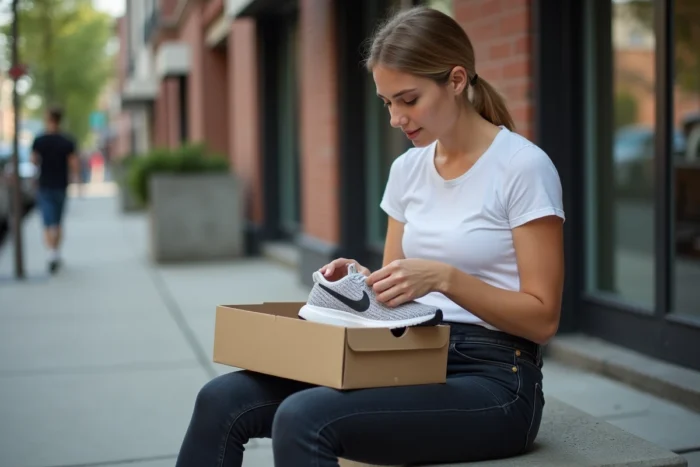
Verification of the Nike barcode via a public database
The UPC or EAN barcode, printed below the SKU code on the label, offers an additional layer of verification. This code identifies the product in a global database managed by GS1, the organization that assigns business identifiers.
The GEPIR (Global Electronic Party Information Registry) database allows you to check who owns the prefix of a barcode. For an authentic Nike product, the prefix should refer to Nike, Inc. If the result shows another company or returns nothing, it is a strong warning signal.
- Scan the barcode with a mobile app (like Barcode Scanner or the phone’s camera) to extract the UPC/EAN number
- Search for this number on the site gepir.gs1.org to verify that the owner of the prefix is indeed Nike
- Compare the product displayed in the results with the model, colorway, and size of the pair in hand
A barcode pointing to an unknown owner disqualifies the pair. This method does not guarantee authenticity on its own (a counterfeiter can also copy a real barcode), but it filters out the most blatant counterfeits, those with entirely fabricated labels.
Label inconsistencies: markers that the serial number does not reveal
The textual data on the label represent only part of the authentication work. What often distinguishes a real pair from a fake is the quality of the printing itself and the consistency between the different elements.
Typography and layout of the label
Nike uses a proprietary font and precise alignment on its labels. On counterfeits, even recent ones, measurable discrepancies can be observed: irregular spacing between lines, characters that are slightly thicker or thinner, and especially a text alignment that is misaligned with the label frame.
Comparing with a high-resolution photo of the label from an authentic pair of the same model remains the most direct method. Visual databases from specialized sneaker authentication sites allow for this line-by-line comparison.
Consistency between label and box
The label affixed to the box includes the SKU, size, and barcode. On an authentic pair, these three data points match exactly between the box and the inner label. Any divergence, even minor (a different size digit, a barcode that does not scan the same result), signals a problem.
Counterfeiters sometimes assemble boxes and shoes from different batches. The box may be authentic while the pair is not, or vice versa.
Limits of the Nike serial number against “super fakes”
High-end counterfeits, sometimes called “super fakes,” are produced with materials and processes close to official production. In some cases, they may come from the same factories outside of contractual production hours.
Given this level of sophistication, verifying only the serial number becomes insufficient. The label, SKU, and barcode can all be correct, as they are copied from a real product.
- The texture of the material (leather, mesh, foam) often differs in feel and weight, even when the visual appearance is faithful
- The interior seams, less visible, show irregularities on counterfeits (loose threads, variable spacing between stitches)
- The pronounced chemical smell upon unboxing often betrays the use of inferior glues and materials
- The NFC chips integrated by Nike on some recent models are a marker that is difficult for counterfeiters to reproduce
Authenticating a pair of Nike sneakers therefore relies on a cross-section of clues. The serial number and SKU code serve as a first filter, the barcode verification via GEPIR adds a second, and the physical examination (typography, seams, materials) closes the loop.
A valid product code does not prove the authenticity of a Nike shoe. Cross-referencing the serial number with GEPIR verification, typographic examination, and physical inspection remains the only approach that holds against current counterfeits.