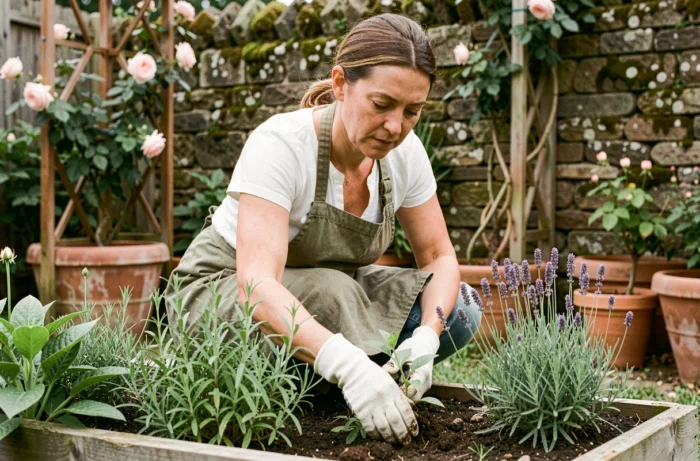
A garden that remains green and structured beyond June requires design choices made in advance, not an accumulation of plants bought on a whim. The substrate, root network, water management, and plant palette form a system. Transforming a garden into a sustainable green space means considering this system as a whole.
Substrate and drainage: the technical foundation of a green garden
The quality of the soil determines everything else. A compact clayey soil retains water in winter and cracks in summer, which stresses the roots and limits growth. Before planting anything, we recommend a simple jar test (sand-silt-clay decantation) to identify the dominant texture.
On heavy soil, adding well-rotted compost mixed with coarse sand improves the structure over several seasons. On sandy soil, it’s the opposite: you need to enrich it with organic matter to increase water retention. This work on the substrate directly determines the density of the plant cover you will achieve.
Drainage deserves the same attention. Water stagnation, even temporarily, causes root necrosis in most Mediterranean perennials. An agricultural drain placed thirty centimeters deep along a flowerbed often suffices to solve the problem, provided there is an outlet. The professionals listed on lejardinierdecorateur.com systematically incorporate this step into their landscaping plans.
Sustainable plant palette: local perennials and mulching to reduce excessive maintenance
The dream garden fantasized in magazines relies on annuals that are thirsty for water and time. The reality of a lasting green space involves perennials suited to the local climate.
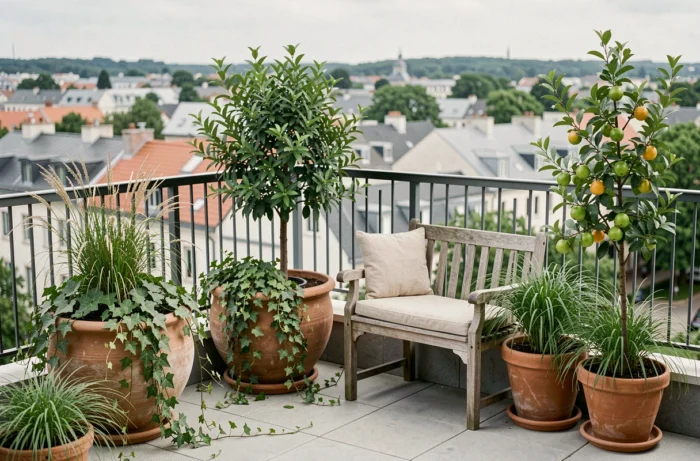
Local perennials significantly reduce maintenance time. Rosemary, cistus, sages, gaura, yarrow: these plants withstand summer drought once established and require only annual pruning. Paired with mineral or organic mulching, they create a dense cover that limits the emergence of weeds.
Since January 1, 2019, individuals can no longer buy or use synthetic phytopharmaceutical products. This regulatory constraint makes the choice of ground-covering perennials even more relevant: a well-planted bed at the right density leaves no room for unwanted plants.
- Low layer (ground cover): creeping thymes, sedums, heucheras for semi-shaded areas. Planting at twenty centimeters apart for complete coverage in two seasons.
- Intermediate layer: ornamental grasses (miscanthus, pennisetum) that bring movement and filter light without blocking views.
- High layer: evergreen shrubs (photinias, eleagnus, pittosporums) pruned for transparency rather than strict hedges, for a natural look and effective screening.
This layering logic creates a vegetative thickness that keeps the garden green all year round, including in winter thanks to evergreens and grasses that retain their dry stems.
Water management in the garden: micro-irrigation and collection
Improperly calibrated watering wastes resources and weakens plants. Excess water promotes fungal diseases, while a lack causes water stress that yellows foliage. We observe that most residential gardens are overwatered on the surface and underwatered at depth.
Buried drip irrigation remains the most effective solution for flowerbeds and hedges. It delivers water directly to the root zone, limits evaporation, and does not wet the foliage. A two-zone timer (flowerbeds and lawn) is sufficient for most medium-sized gardens.
Rainwater harvesting complements the system. A one-thousand-liter tank connected to a downspout covers the watering needs of a thirty-square-meter flowerbed for several dry weeks. The return on investment is quick, and rainwater, free of lime, is better suited for many acid-loving plants.
Outdoor lighting and furniture: structuring the living space in the garden
A green garden loses all interest at night without thoughtful lighting. The current trend moves away from powerful spotlights to favor low and diffuse sources that extend the use of the garden without light pollution.
Solar bollards along a path, a recessed spotlight at the base of a remarkable tree, a LED strip under the edge of a terrace: lighting should guide the eye and create layers, not flood the scene. The ideal color temperature for a garden is around 2,700 kelvins, a warm white that respects the plant ambiance.
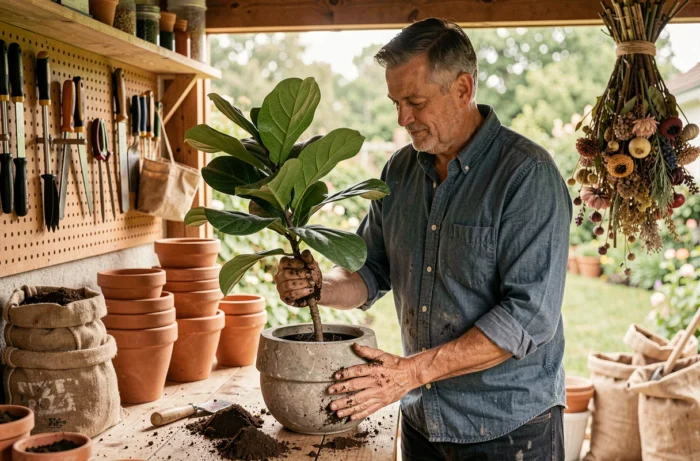
Outdoor furniture has also evolved. Modular structures, easy to reconfigure according to the seasons and uses, are gradually replacing fixed garden sets. Treated aluminum, high-density woven resin, or certified wood: the choice of material depends on exposure and the level of maintenance you are willing to accept.
- Shaded terrace: prefer a bioclimatic pergola with adjustable slats rather than a retractable awning, to regulate heat and light without partitioning the space.
- Dining area: plan for a stable flooring (paving on pedestals, composite wood) so the table remains level without sinking into the lawn.
- Reading or resting corner: a hammock or swing under a mature tree creates a micro-space without heavy work.
Functional biodiversity: a green garden that works for itself
A dream green space is not limited to its visual aspect. A garden that welcomes pollinators, beneficial insects, and birds naturally regulates its pests and enriches its soil.
Leaving a controlled fallow area at the back of the plot, installing an insect hotel near the vegetable garden, planting berry shrubs for wintering birds: these actions require little investment and transform a decorative garden into a resilient ecosystem. Recent studies on therapeutic gardening also confirm that regular contact with a living and diverse environment has measurable effects on stress and mental well-being.
The most accomplished green garden is one that requires fewer and fewer interventions over the years. Well-chosen perennials, soil nourished by its own decomposing mulch, and water management adjusted to the actual needs of the plants: this virtuous circle establishes itself in three to four seasons and lasts for decades.