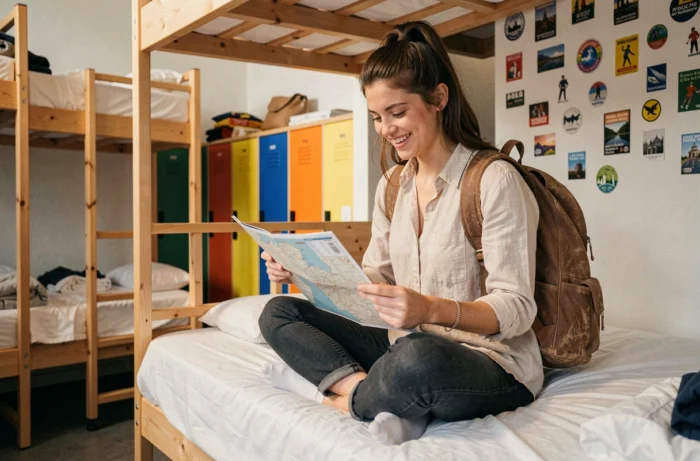
When arriving in an unknown city at 11 PM with a backpack and a tight budget, the choice of accommodation is no longer a question of theoretical comfort. It’s a practical decision that determines the rest of the stay: quality of sleep, encounters, safety, mobility. The types of accommodations for young travelers have multiplied in recent years, each meeting a specific need on the ground.
Private rooms in hostels: the silent transformation of the hostel
The classic reflex for a young traveler remains the youth hostel. Dormitories with eight or ten bunk beds still exist, but the underlying trend is moving elsewhere. According to the Cloudbeds 2026 State of Hostels Report, the demand for private rooms is growing faster than that for dormitories, with stable rates for the former and a decline for the latter.
In practice, many hostels now offer double or single rooms, sometimes with private bathrooms, at a price point between the dormitory and budget hotel. For those looking to compare options, the accommodations on Jeunes Voyageurs allow for a quick overview of what’s available by destination.
This shift towards private accommodations does not mean the end of the dormitory. Feedback on this point varies by region. In Southeast Asia, the dorm bed often remains the norm among backpackers. In Europe, solo travelers are willing to pay a premium for a quieter sleep, especially when the hostel offers friendly common areas (shared kitchen, rooftop, coworking).

Homestays and exchanges: two different logics
Homestays actually cover two distinct practices that are often confused. The first is the paid room with a local host, through short-term rental platforms. You pay a price, get a room in an apartment or house, and the interaction with the host varies from a simple key exchange to a real sharing of daily life.
The second is non-commercial exchange: free accommodation in exchange for a service (pet sitting, help on a farm, language lessons) or simply through hospitality networks. This option attracts young travelers who want a deeper cultural immersion, but it requires flexibility and a real ability to adapt.
What to check before booking with a host
- The cancellation policy and access conditions to the accommodation (hours, keys, emergency contact), especially in countries where time zones complicate communication
- Recent reviews from other travelers of the same profile (solo, couple, budget) to assess the reliability of the host
- The actual location in relation to transport, as a cheap accommodation but far from the center can be costly in daily travel
The European Union has tightened regulations on short-term rentals, affecting availability in certain tourist cities. In Barcelona, Amsterdam, or Lisbon, the supply of homestays fluctuates according to the municipal restrictions in place.
Coliving and hybrid hostels: the rising format for solo travelers
Coliving targets a specific profile: the young traveler who stays several weeks in a city, often working remotely or transitioning between two stages. You rent a room in a shared space with a kitchen, living room, and sometimes an office, for a duration of a month or more.
This format differs from the hostel by the length of stay and the atmosphere. No daily turnover, no parties in the dorm. Coliving focuses on stability and productivity, with reliable wifi and quiet spaces. The price is generally lower than a standard furnished studio in the same city.
Hybrid hostels borrow from this model. Hostel Management reported in September 2026 that the best-performing establishments now integrate coworking spaces, public cafes, and wellness areas. The festive dormitory is losing ground in favor of a more segmented offering.

Solo travelers: sociability on demand
The Hostelworld State of Solo Travel 2025 confirms that solo travelers remain the main driver of hostel and coliving occupancy. Their expectations have evolved: they want to choose when and how to socialize, not be locked into an imposed atmosphere. Cultural connection and autonomy are as important as price.
Budget hotels and capsule hotels: alternatives not to be overlooked
The budget hotel has not disappeared from the radar of young travelers. In some countries (Japan, South Korea, Eastern Europe), capsule hotels or budget chains offer a value for money comparable to that of a private room in a hostel, with the advantage of truly personal space.
The capsule hotel, which originated in Japan, offers an individual bed in a closed compartment, with light, a socket, and sometimes a screen. It’s a pragmatic solution for one or two nights in transit in a big city when you don’t need communal space or social interaction.
- Capsule hotels are suitable for short layovers and late arrivals, thanks to continuously open receptions
- European budget chains often offer breakfast included, which reduces the overall cost of the day
- In cities where the hostel supply is low or saturated, the budget hotel remains the most reliable backup plan
The choice between these options depends on three variables: the length of stay, the need for sociability, and the actual daily budget (accommodation plus transport plus meals). A low-cost dorm bed in a remote area can end up being more expensive than a well-located budget hotel room. Before booking, it’s worth taking the time to write down these three criteria rather than comparing dozens of listings based on gut feeling.