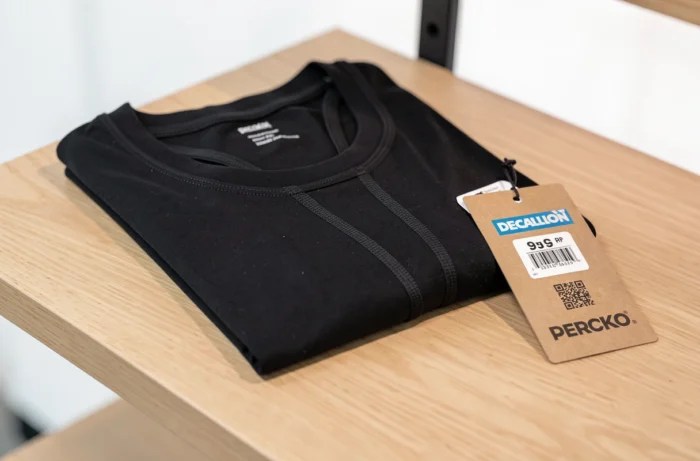
The Percko t-shirt is based on a system of elastic tensors integrated into the fabric, designed to guide the shoulders and spine into a neutral position. Available on the Decathlon website among other posture correctors, this product is now positioned as a complementary medical device, rather than as a standalone solution for back pain treatment. This distinction, rarely highlighted in consumer comparisons, changes the perspective on its actual effectiveness.
Elastic tensors and biomechanics: what the textile can (and cannot) do
The principle of the Percko t-shirt relies on tension bands arranged in an X shape on the back, which exert passive traction on the shoulders. The stated goal: to engage proprioception to encourage the wearer to straighten up, rather than mechanically holding the spine in place like a rigid orthosis would.
The nuance is technical but crucial. A rigid corrector (like a lumbar belt or corset) partially immobilizes the affected vertebral segment. The textile tensors, on the other hand, do not generate sufficient mechanical strain to alter spinal alignment. Their action is limited to sensory feedback: the fabric pulls slightly when the wearer slumps, creating a skin signal.
We regularly observe in clinical practice that this type of proprioceptive feedback works in the first weeks of use. The wearer corrects their posture through conditioned reflex. The problem arises later: either the user integrates the postural pattern without the garment (which is the optimal scenario), or they develop a dependency on the external signal without strengthening the deep stabilizing muscles.
A doctor quoted on a specialized forum summarizes the risk well: the tensors can make back muscles “lazy” if wearing the t-shirt replaces muscle strengthening. This observation aligns with the position of physiotherapists who recommend limited time use, coupled with active exercises.
To better understand the price of the Percko t-shirt at Decathlon and its positioning against alternatives, we must first look at what survey data reveals about user satisfaction.

Perceived effectiveness of the Percko t-shirt: self-reported data and their limits
Percko communicates about an internal quantitative survey dated March 2024, according to which a large majority of regular users surveyed report relief from their pain in the long term. This figure circulates widely, but its self-reported nature deserves critical examination.
A satisfaction survey conducted by the brand itself, focusing on the wearers’ feelings, does not constitute proof of clinical effectiveness in the medical sense. No randomized controlled trial published in an indexed journal currently validates the specific effectiveness of Percko tensor t-shirts on reducing lumbar or cervical pain.
Que Choisir has labeled back correcting t-shirts as “useless” in their analysis, pointing out the lack of robust scientific evidence. The position is clear-cut, but it reflects a consensus shared by some health professionals: no passive textile replaces a targeted muscle strengthening program.
What user reviews reveal nonetheless
Feedback on forums and in stores outlines a typical profile of a satisfied user: sedentary individuals, working on screens for several hours a day, with moderate postural pain (no diagnosed disc or arthritic pathology). For this profile, proprioceptive feedback seems to provide a real subjective benefit during the first weeks.
The most disappointed users are often those who expected a curative solution for established chronic lower back pain. The Percko t-shirt was never designed to treat a pathology, and its reclassification as a complementary medical device confirms this.
Price of the Percko posture corrector and alternatives at Decathlon
The price of a Percko t-shirt is significantly higher than that of generic posture correctors available in the Decathlon catalog. This price gap raises a legitimate question of quality-effectiveness ratio, especially when comparing the mechanisms of action.
- The bras and vests with adjustable straps offered by distributor brands provide firmer mechanical support, for a fraction of the price. Their limitation: less comfort over long periods of wear.
- Kinesiology taping, used in rehabilitation, reproduces a comparable proprioceptive effect at a negligible cost, but requires application by a practitioner or good technical mastery.
- A muscle strengthening program supervised by a physiotherapist (deep core stabilization, scapular stabilization exercises) remains the only approach whose effectiveness is documented by clinical trials on chronic lower back pain.
The pricing strategy of Percko is justified by the textile quality, daily comfort of use (the t-shirt can be worn under a shirt without being visible), and the design work on the tensors. However, we recommend considering this product as a complement to active muscle work, never as a substitute.
Office posture: why the t-shirt alone is not enough
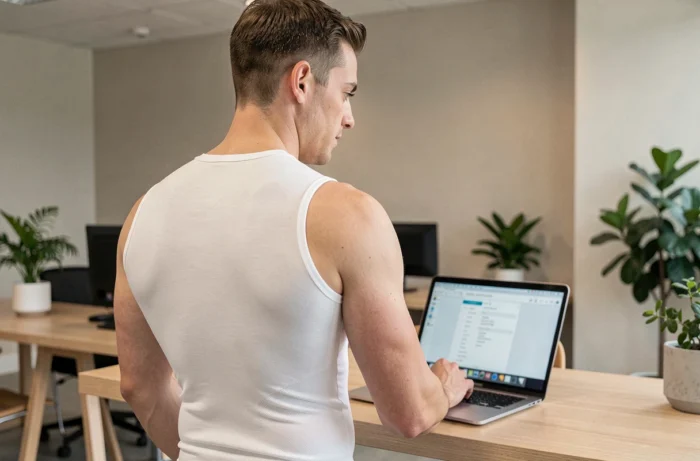
The ergonomics of the workstation remain the determining factor in preventing postural pain. The MSA reminds us in its recommendations on gestures and postures in front of a screen that the height of the seat, the distance from the screen, and the angle of the elbows directly condition the load on the spine. No garment compensates for a poorly adjusted desk.
Wearing a Percko t-shirt on a chair without lumbar support, in front of a screen that is too low, amounts to treating the symptom without addressing the cause. The logical order is first ergonomics, then strengthening, and possibly the corrective textile.
Health professionals who integrate this type of device into their care usually prescribe it for a limited duration (a few weeks), until the patient acquires postural habits through active rehabilitation. Beyond that, the risk of proprioceptive dependency on the garment increases, and the benefit fades.
The Percko t-shirt remains an interesting tool for raising awareness among sedentary wearers about their posture. Its effectiveness entirely depends on the context of use and the wearer’s commitment to an active strengthening approach. At this price point, expecting more than just sensory feedback seems reasonable, and current data do not allow for promising more.