Butternut squash is a sprawling gourd whose vines can exceed three meters in length. In vertical cultivation, this vigor becomes an asset, provided that each element of the structure is sized to support the combined weight of the foliage and fruits. Most failures do not stem from a lack of sunlight or watering, but from technical choices made too early, before the plant reveals its mechanical constraints.
Anchoring the trellis and wind resistance: a point that many overlook
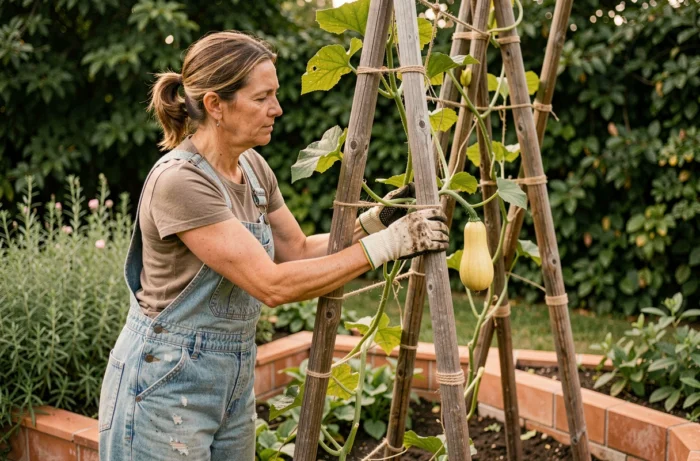
A butternut laden with fruits and leaves presents a considerable wind catch. Simply erecting a panel or arches anchored in the ground without bracing exposes the entire structure to tipping at the first strong gust of wind. Feedback from gardeners reports complete collapses during storms or strong winds at the end of summer, when the fruits are heavy and the foliage dense.
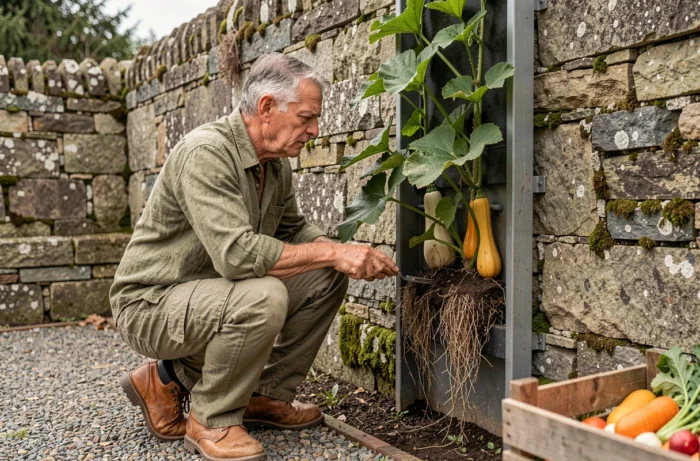
A reliable trellis for vertical butternut relies on posts driven at least 45 cm into the ground. At this depth, the base resists oscillations. Add cross braces or a wall attachment if the support is against a facade. On a terrace, plan for a heavy weight at the base, as a trellis anchored solely in the substrate of a pot or container can tip under the load.
Several resources detail these precautions, and vertical butternut cultivation on Eco Habitat specifically addresses this type of structural risk often underestimated in general guides.
Height of the support and support for butternut fruits
Butternut is not a zucchini. Its fruits commonly weigh between 0.9 and 2.3 kg each. Suspended from a stem, they exert a constant pull on the peduncle and the trellis. Planning for a support of at least 1.80 m high allows the stems to climb without crowding, and facilitates the installation of supports under each fruit.
Support sling under each fruit
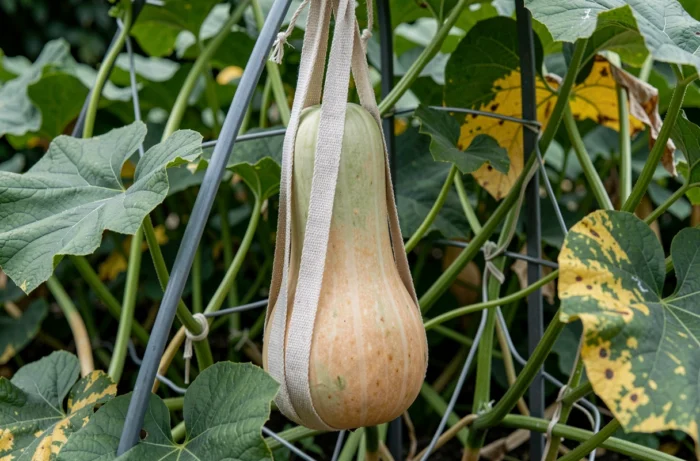
The most common mistake is to let butternuts hang freely. The peduncle eventually gives way under the weight, and the fruit falls before ripening. The solution is simple: a net or fabric tied to the trellis under each fruit, forming a pocket that distributes the load. An old pantyhose, a burlap sack, or a vegetable net will work.
Check the slings weekly. The fruit grows quickly in summer, and a support that is too tight can compress the skin and cause deformities or injuries that promote rot.
Soil, watering, and fertilization in vertical butternut cultivation
Growing vertically does not change the root needs of butternut. The plant remains hungry. However, verticality alters the water dynamics: the substrate at the base of the support dries out faster than in a traditional bed, because the foliage up high captures more wind and accelerates evapotranspiration.
- Generously mulch the base of the plant (at least ten centimeters thick) to retain moisture and limit watering.
- Water at the base, never on the foliage. Standing water on the leaves promotes powdery mildew, a problem exacerbated when the leaves are crowded along a trellis.
- Add mature compost or an organic fertilizer rich in potassium at the time of fruit set. An undernourished butternut aborts its fruits long before they reach a harvestable size.
Container or raised bed cultivation
In pots, the volume of substrate is the limiting factor. A container that is too small dries out in a few hours in hot weather and does not provide enough nutrients over time. Plan for a container of at least 40 to 50 liters per plant. The trellis should be fixed independently of the pot (to the wall, to a railing), otherwise the weight of the fruits may tip the whole thing over.
Pruning and guiding stems on a vertical trellis
Letting a butternut grow freely on a trellis creates a plant tangle where light cannot penetrate and diseases take hold. Limiting each plant to two or three main stems concentrates energy on a reasonable number of fruits and aerates the foliage.
Pinch the secondary stems after the second leaf beyond the last retained fruit. This pruning directs the sap towards the existing fruits rather than new shoots. Tie the stems to the trellis with soft ties (raffia, fabric strips) without tightening, so as not to strangle the stem as it thickens.
- Remove yellowed or spotted leaves as soon as they appear to slow the spread of powdery mildew.
- Guide the tendrils towards the trellis mesh: they will cling by themselves in a few hours if they touch a support.
- Inspect the base of the stems weekly. A crack or strangulation from a tie that is too tight can cause the entire branch above to be lost.
Butternut varieties suitable for trellising
Not all butternut varieties lend themselves equally well to verticality. Favor varieties with moderately sized fruits, remaining under two kilograms at maturity. Selections with large fruits, exceeding three kilograms, exert too much strain on the peduncle and the trellis, even with slings.
Vining varieties with vigorous tendrils climb more easily than bush-type varieties. Check this information on the seed packet or with the seed supplier before planting. A compact butternut, intended for ground cultivation, will produce dense foliage but will not climb without intensive and constraining trellising.
A final pitfall: sowing too densely at the base of the trellis. Two plants spaced at least 80 cm apart are sufficient to cover a panel 1.80 m wide. Beyond that, root competition and lack of light reduce the harvest more than they increase it.