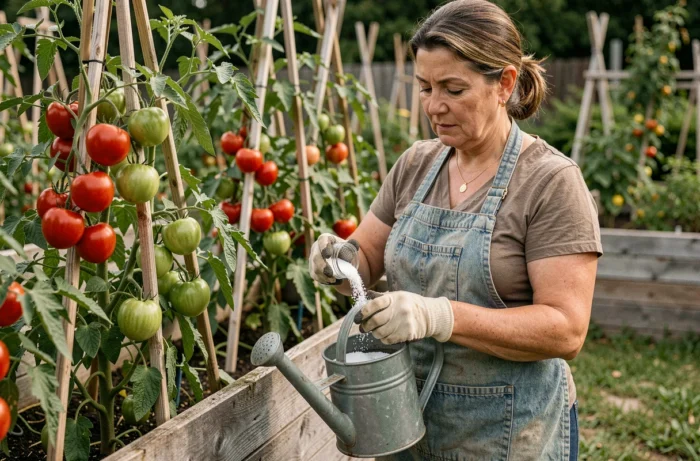
A packet of baking soda costs a few cents and can be found in every kitchen. When applied to the vegetable garden, this product can protect tomatoes from certain fungal diseases and slightly alter the soil pH. The problem is that the line between a helpful boost and a counterproductive action is thin. If mismeasured or used too frequently, baking soda can damage the plants instead of helping them.
Concentration threshold and soil pH: the trap of excess baking soda on tomatoes
Have you ever noticed leaves turning yellow for no apparent reason after a homemade treatment? This phenomenon has a name: chlorosis. It occurs when the soil becomes too alkaline, blocking the absorption of calcium and magnesium by the roots.
Repeated watering with a baking soda solution exceeding 1% concentration can shift the soil pH to a zone unfavorable for tomatoes. Baking soda is not a fertilizer to be used at every watering; it is a one-time application.
The dosage rule to remember: do not exceed one teaspoon of baking soda per liter of water. Beyond that, the risk of lasting alkalinization increases, and the growth of the plants slows down. By using baking soda for watering tomatoes at spaced intervals, you can take advantage of its fungicidal properties without upsetting the soil.
Some university specialists also advise against repeated use on tomatoes, precisely because the cumulative effect on pH is not negligible. If your soil is already calcareous, it’s better to refrain or test the pH before each application.
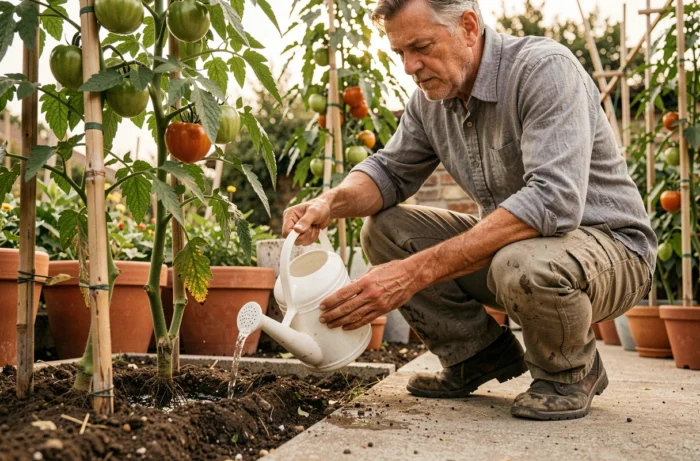
Baking soda anti-downy mildew treatment: preparation and application conditions
Downy mildew is the disease that destroys the most tomato crops. Caused by the fungus Phytophthora infestans, it spreads very quickly as soon as humidity and heat combine. Baking soda acts here by altering the surface pH of the leaves, which slows down the development of spores.
Fungicidal solution recipe
The preparation is simple, but three details make the difference between an effective treatment and a waste of product:
- Dissolve one teaspoon of baking soda in one liter of warm water, then add half a teaspoon of liquid black soap (the soap helps the solution adhere to the leaves instead of running off)
- Prepare the solution just before use, as baking soda quickly loses its effectiveness when dissolved and exposed to air
- Spray in the late afternoon or early morning, never in full sun or during high heat, to avoid burning the foliage
The spraying should be done on both sides of the leaves. There’s no need to soak the plants: a light mist is sufficient. The goal is to cover the leaf surface without the solution dripping down to the ground in large quantities.
Reasonable treatment frequency
One application every ten to fifteen days is sufficient for prevention. In case of a declared downy mildew attack, sprays can be increased to once a week for two to three weeks, then return to a spaced schedule.
More frequent treatment does not enhance protection. On the contrary, an excess of baking soda on the leaves can create a whitish deposit that limits photosynthesis.
Preventive actions that matter more than baking soda in the vegetable garden
Baking soda alone will not save a poorly managed tomato crop. Experienced gardeners know this: mechanical prevention always precedes chemical or natural treatment.
Immediately removing the first spotted leaf with a disinfected pruner prevents the spread of downy mildew much more effectively than a late spray. This one-second action is often the most decisive of the season.
Here are practices to combine with baking soda for resilient tomato plants:
- Water strictly at the base of the plants in the morning, without wetting the foliage (splashing spreads spores)
- Mulch the soil around the tomato plants to limit soil splashes on the lower leaves
- Space the plants sufficiently to allow air circulation between them and for the leaves to dry quickly after dew
- Disinfect tools and hands between each plant during pruning, especially if one plant shows signs of disease
- Prevent the lower leaves from touching the ground by removing them as soon as they turn yellow
Mulching and watering at the base do more than any treatment to keep tomatoes healthy. Baking soda is a supplement, not a replacement for these basic actions.
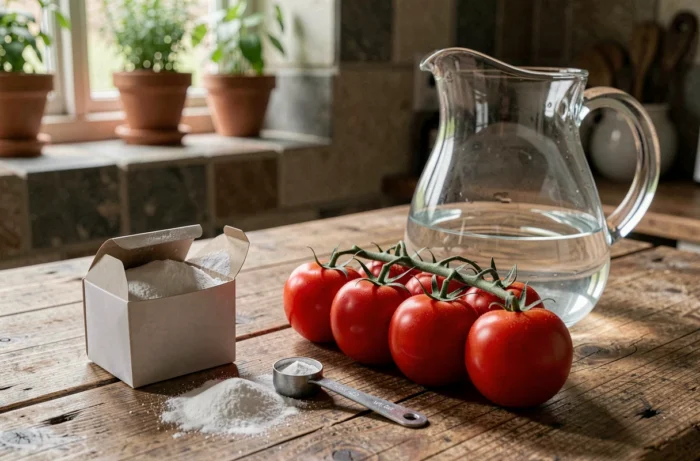
Baking soda and acidic soil: a targeted use to correct pH
Aside from its fungicidal role, baking soda is sometimes used to slightly raise the pH of overly acidic soil. Tomatoes prefer soil close to neutrality. A distinctly acidic soil can limit their development and reduce the flavor of the fruits.
For this use, sprinkle a thin layer of baking soda directly on the soil around the plants, then water normally. Testing the soil pH before and after is necessary to avoid exceeding the desired correction. Test strips cost a few euros at garden centers.
This type of correction only concerns soils confirmed to be acidic. On neutral or already calcareous soil, adding baking soda does not provide any benefit and can block the absorption of certain nutrients by the roots.
Baking soda remains a useful ally in the vegetable garden, provided it is regarded for what it is: a supplementary product, not a miracle treatment. Measured dosing, spaced applications, and good cultural practices form a trio far more reliable than randomly emptying a packet at the base of the tomatoes.