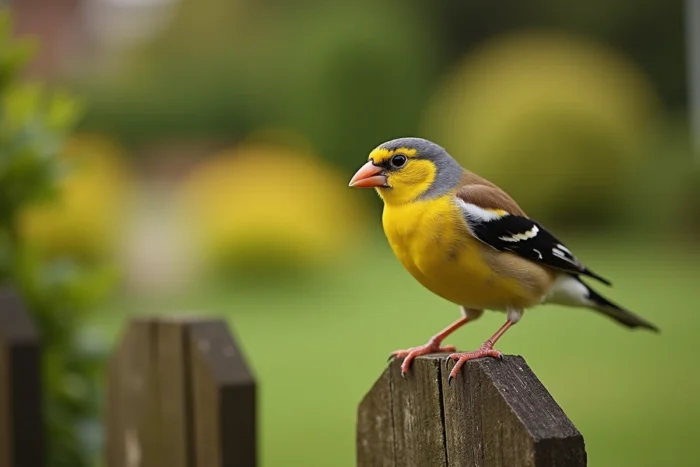
A parrot singing at the top of its lungs, a budgerigar that clings to your hand, a canary hopping on its perch: these behaviors reassure owners. They are interpreted as signs of happiness. The ethological reality is more nuanced. The well-being of a pet bird is measured through a range of bodily, vocal, and social signals, some of which can mislead an untrained observer.
Bird Body Language: What Posture Really Reveals
The posture of a resting bird is the first reliable indicator. A relaxed bird stands on one leg, feathers slightly puffed, eyelids half-closed. This position indicates an absence of defensive vigilance, a sign that the animal does not perceive any threat in its immediate environment.
The regular grooming of feathers (preening) deserves particular attention. A bird that maintains its plumage smoothly, without aggression or feather plucking, shows a stable physiological state. In contrast, excessive grooming or feather plucking (compulsive feather pulling) signals deep distress, often related to stress or boredom.
The tail and wings provide complementary clues. A rapid tail flutter after a flight or social interaction corresponds to a form of positive excitement. Wings slightly away from the body, without excessive heat context, may indicate a posture of solicitation or play. Knowing how to observe a happy bird involves this fine reading of micro-movements, which varies by species.
Vocalizations and Well-Being in Parrots: Decoding the Cries
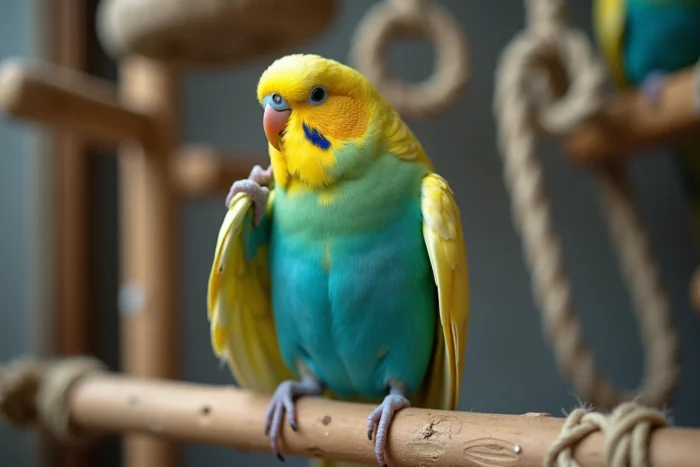
Vocalizations represent the richest communication channel among psittacines (parrots, budgerigars, cockatoos). A healthy parrot emits a varied sound palette throughout the day: melodious songs in the morning, chatter during active phases, softer sounds in the evening before resting.
Vocal diversity matters more than sound volume. A bird that limits itself to a single repetitive cry, especially if it is shrill, often expresses distress or an unsatisfied contact call. A parrot that modulates its sounds, mimics noises from its environment, or “talks” in an interactive context demonstrates active cognitive engagement.
Apps like “bird translator” have recently appeared on download platforms. These tools remain playful and non-scientific: research in bioacoustics has not yet reached the stage of reliably translating avian emotions through algorithms.
Alarm Calls and Contact Calls
Differentiating an alarm call from a simple contact call helps assess the emotional state. The alarm call is brief, high-pitched, often accompanied by a frozen posture or sudden flight. The contact call occurs when the bird seeks to locate a member of its group (including humans) and stops as soon as it receives a response.
A bird that emits moderate contact calls and calms down quickly shows a secure attachment to its living environment. A bird that cries continuously, even in the presence of its references, may exhibit separation anxiety or an unsuitable environment.
Apparent Happiness or Real Well-Being: The Limits of Human Interpretation
The temptation to anthropomorphize avian behaviors is the main pitfall of domestic observation. A bird that seeks physical contact with its owner does not necessarily express “happiness” in human terms. This behavior may stem from a dependency related to imprinting (early habituation to humans) rather than a free social choice.
Ethology distinguishes several dimensions of animal well-being:
- The absence of physical suffering (health, appropriate diet, sufficient space to spread wings and fly)
- The ability to express natural behaviors (foraging, social interactions with peers, exploration)
- A generally positive emotional state, assessed by the frequency of play behaviors, social grooming, and voluntary resting
A captive parrot may check the first box without satisfying the second. Play and proximity are not enough to ensure lasting well-being if the bird has no access to conspecifics or real flying space.
Habituation to Humans and Observation Bias
Birds hand-raised from a young age develop a strong bond with humans, sometimes at the expense of their ability to interact with other birds. This phenomenon, well documented in African grey parrots and cockatoos, produces animals that seem “happy” in their domestic routine but exhibit behavioral issues as soon as the routine changes (moving, prolonged absence of the owner, arrival of a new pet).
Field reports vary on this point: some breeders believe that a well-socialized hand-raised parrot leads a satisfactory life, while ethologists emphasize that captivity remains a structural constraint for a flying and social species.
Warning Signals: When Behavior Shifts
Some signs should clearly alert to a deterioration in well-being:
- Feather plucking, which can lead to self-mutilation in stressed psittacines
- Prolonged apathy, with a bird remaining curled up on its perch without reacting to usual stimuli
- Motor stereotypies (repetitive swaying, back-and-forth movements on the perch) comparable to those observed in captive mammals
- A sudden change in vocalizations, particularly an unusual silence in a normally chatty bird
These behaviors are not always reversible. A parrot that has developed chronic feather plucking may continue to pull its feathers even after its living conditions improve, due to the persistence of the acquired behavior.
Careful observation of body language, vocal diversity, and social interactions remains the best available tool for assessing a bird’s well-being. However, this assessment has its blind spots: an animal adapted to captivity is not necessarily a thriving animal in ethological terms. Keeping this distinction in mind allows for more accurate adjustments to the environment, diet, and care, without projecting emotions onto the bird that belong to the observer.