Making your own swimsuit suitable for menstruation requires understanding what distinguishes a reliable textile assembly from a simple lined fabric. The central question is technical: which layers to use, in what order, and with what limits compared to laboratory-tested products? This guide compares materials accessible to seamstresses with those of industrial menstrual swimsuits, then details the steps for making and health precautions.
Membranes and technical fabrics: what a homemade project can (and cannot) replicate
An industrial menstrual swimsuit relies on three functional layers stacked in the crotch area: a draining layer in contact with the skin, an absorbent textile, and a breathable waterproof membrane. This fine architecture must withstand chlorinated water, saltwater, and the pressure of movement without swelling.
The main difficulty for a homemade project concerns the waterproof membrane. Manufacturers use laminated membranes tested under hydrostatic pressure, validated in laboratories to ensure waterproofing under stress. These materials, often PUL (laminated polyurethane), are available at specialized haberdashery, but their quality varies significantly from supplier to supplier.
Before getting started, it is helpful to consult detailed resources to create a menstrual swimsuit and assess the feasibility of the project based on your sewing level.
| Layer | Function | Industrial Material | Homemade Alternative | Homemade Limitation |
|---|---|---|---|---|
| Draining (skin contact) | Drain blood to the absorbent | Technical quick-drying mesh | Fine synthetic jersey (polyester) | Slower drying, less effective drainage |
| Absorbent (middle) | Retain the flow | Calibrated technical microfiber | Bamboo or commercial microfiber terry | Non-certified absorption capacity |
| Waterproof (outer crotch) | Block any leaks | Laboratory-tested laminated PUL membrane | PUL from haberdashery or polyurethane-coated fabric | No hydrostatic pressure testing |
The table highlights a structural gap: a homemade swimsuit lacks any standardized validation. It may work for light flow or as a supplement to other protection, but its reliability remains empirical.
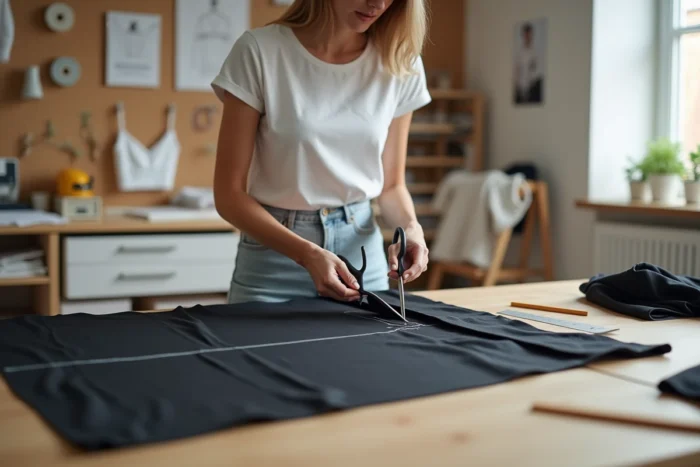
Pattern and assembly of a menstrual swimsuit bottom
The starting point is a classic swimsuit bottom pattern (swim briefs) adjusted to the body shape. The crotch area must be widened compared to a standard bottom to accommodate the three layers without creating visible thickness.
Cutting and preparing the layers
- Cut the draining piece from fine polyester jersey, to the exact dimensions of the crotch of the pattern, with a seam allowance of 0.7 cm on each edge.
- Cut the absorbent (bamboo terry or microfiber) slightly smaller than the draining piece to avoid visible side bulk under the outer fabric.
- Cut the PUL to the same dimensions as the draining layer, with the laminated side facing outwards to block the flow from passing to the swimsuit fabric.
The assembly is done in a sandwich: draining on top, absorbent in the middle, PUL underneath. The three layers are sewn together at their edges before being attached to the lining of the swimsuit bottom.
Sewing points and finishes
Polyester thread is preferable to cotton thread, which degrades in chlorinated water. Seams should be flat and not protruding to avoid irritation on the vulva. A narrow zigzag stitch on the edges prevents fraying of the PUL, which tends to delaminate if the finishes are rough.
The insert is then sewn onto the inner lining of the swimsuit bottom. Care must be taken not to perforate the PUL membrane with stitches that are too tight or an unsuitable needle. A ballpoint jersey needle, size 70 or 80, minimizes this risk.
Chlorine resistance and health safety of materials
Technical fabrics available to the general public are not all designed to withstand pool water. Chlorine degrades certain fibers and can alter absorption or waterproofing properties after a few uses.
From a health perspective, consumer associations (notably Test-Achats in Belgium) have conducted testing campaigns targeting the presence of PFAS and azo dyes in the absorbent areas of menstrual briefs and swimsuits. These substances, used in some water-repellent treatments, are in prolonged contact with the vulva.
The gradual tightening of the REACH regulation at the European level is pushing manufacturers to switch to PFAS-free treatments. For a homemade project, this means checking the composition of the purchased PUL and favoring suppliers who certify the absence of these substances. A PUL labeled Oeko-Tex Standard 100 offers a minimal guarantee level regarding chemical residues.
Care for the homemade menstrual swimsuit
Rinsing with cold water immediately after use is the first non-negotiable step. Hot water sets blood in the fibers and makes subsequent cleaning much more difficult.
Machine washing should be done at low temperatures, without fabric softener. Fabric softener leaves a film on the fibers that reduces absorption capacity and can clog the micropores of the PUL membrane. A delicate cycle with mild detergent is sufficient.
Air drying is preferable. High-temperature tumble drying risks delaminating the PUL and reducing the lifespan of the insert to just a few uses.
Limitations of a homemade menstrual swimsuit compared to tested models
The fundamental difference between a homemade swimsuit and an industrial product lies in validation. Specialized brands have their membranes tested under hydrostatic pressure in laboratories and certify a precise absorption capacity. A homemade project cannot replicate these tests, leaving a margin of uncertainty regarding performance in real conditions, especially in cases of heavy flow or prolonged swimming.
For light to moderate flow and short swims, a well-assembled swimsuit with quality materials can offer adequate protection. Beyond that, combining the homemade insert with another internal protection remains the safest option until the reliability of the assembly is confirmed after several uses in real conditions.