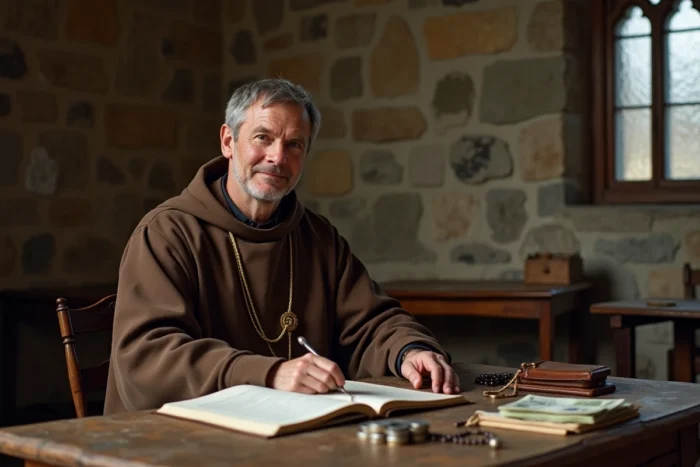
A Catholic monk in France does not receive a salary. The term itself is legally inappropriate: the monk is not an employee, does not sign any employment contract, and does not appear on any payslip. His livelihood relies on a communal system where the monastery provides for his material needs (housing, food, clothing, care). The question “how much does a monk earn” therefore requires a structurally different answer than one would give for a diocesan priest or a chaplain.
Vow of poverty and canon law: the legal framework of the monk
The monk takes three perpetual vows: obedience, chastity, and poverty. The latter vow has direct patrimonial consequences. Under canon law, a religious who takes solemn vows renounces personal ownership of his property. Any income he might generate (from work, an inheritance, a donation) is given to the community.
In practice, a Benedictine, Cistercian, or Carthusian monk does not have a personal bank account funded by an employer. If the community gives him an amount for a one-time purchase (a book, a medical trip), it is an internal allowance, not income in the fiscal sense. This distinction between communal support and individual remuneration explains why some websites display fanciful amounts while trying to impose a traditional salary scale on a reality that does not lend itself to that.
To delve deeper into this question, you can consult the salary of a monk on Bretagne Émeraude, which details the nuances between diocesan priests and religious.
Monastery resources: how the community finances daily life
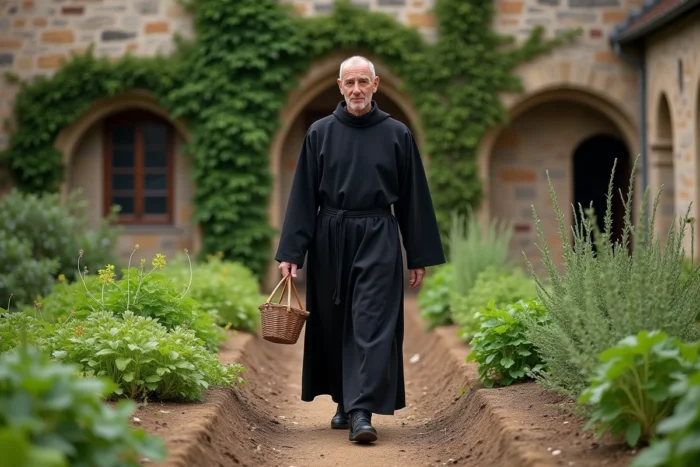
While the monk earns nothing personally, the monastery has income. This income covers all collective expenses, from meals to building maintenance. The sources vary by abbey, but a few items are consistently present.
- Own economic activities: brewery (like at the Abbey of Saint-Wandrille), cheese-making, jams, cosmetic products, printing. Some abbeys also manage guesthouses for retreatants, charged at modest prices.
- Donations and legacies: offerings from the faithful, bequests, specific collections during celebrations. This item represents a variable but often significant part of the budget.
- Property income: rental of agricultural land, forests, or ancillary buildings. Some monasteries have an ancient land heritage that generates regular rents.
The overall budget of a monastery is pooled. Each monk receives what he needs, no more, no less. The Conference of Bishops of France reminds us that religious institutes are governed by their own constitutions, distinct from the regime of diocesan priests, who receive an individual salary.
Social coverage and retirement of monks in France
Monks and nuns fall under the CAVIMAC (Pension, Disability, and Health Insurance Fund for Religious). This fund, managed by Social Security, covers members of congregations and religious communities. The monastery pays the corresponding contributions for each religious.
The pension paid by CAVIMAC remains modest. Since the monk has never contributed based on an individual salary, the amount of his pension is among the lowest in the French system. The Diocese of Angers notes that the pensions of religious are “difficult to quantify” as they vary according to the length of contributions and any uncovered periods.
In practice, a retired monk often continues to live within his community. The CAVIMAC pension is paid to the monastery, which incorporates it into its collective budget. The elderly monk still benefits from the same support system, with no significant change in his daily life.
Comparison with the diocesan priest
A diocesan priest, on the other hand, receives an individual allowance set by the Conference of Bishops of France. In 2023, this reference amount was 1,009 euros net per month, including mass fees. The Diocese of Angers indicates that it pays an average of 1,035 euros monthly to its active priests.
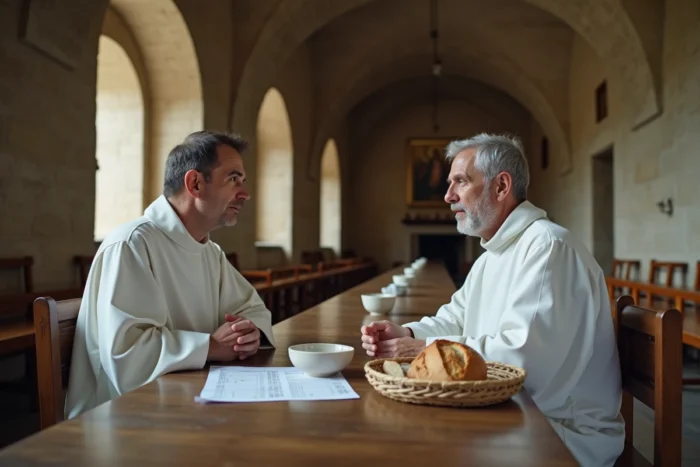
The monk receives nothing comparable personally. The gap does not reflect an inequality of treatment but two distinct logics: the diocesan priest lives alone in a presbytery and must cover part of his expenses, while the monk lives in a community where everything is shared.
Particular case of Alsace-Moselle and salaried monks
The concordat regime of Alsace-Moselle, inherited from the Concordat of 1801, provides that the State pays certain ministers of religion. This provision concerns priests, pastors, and rabbis assigned to recognized positions, but it does not apply to monks living in community. A monk residing in an Alsatian abbey remains subject to the same communal regime as his counterparts in the rest of the territory.
However, there are marginal cases where a religious holds a paid external position (teaching in a Catholic institution under contract, hospital chaplaincy). In this case, the religious receives a salary, but it is entirely given to the community under the vow of poverty. The monk keeps nothing for himself.
The annual personal income of a Catholic monk in France is therefore, strictly speaking, zero. His material life relies entirely on the community that welcomes him, financed by collective work, donations, and the monastery’s assets. CAVIMAC provides for his social coverage and retirement, but these benefits contribute to the common budget. The monk earns nothing; he receives what he needs.