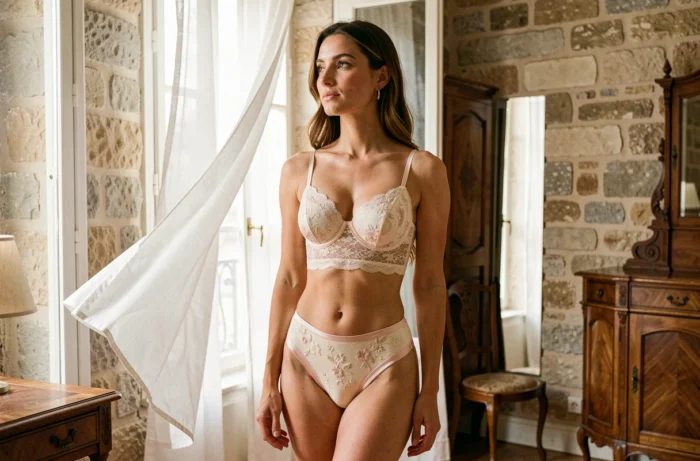
The French lingerie market is undergoing a silent transformation. Behind the lace and silk displays, shopping habits and consumer expectations have significantly shifted since 2024. French lingerie remains a benchmark for textile expertise, but changes are happening regarding comfort, materials, and traceability requirements.
Wire-free lingerie: the segment reshaping the French market
Market analyses published in 2024 and 2025 converge on one point: wire-free bras are progressing faster than underwired models. Bralettes, sports bras, and soft triangles are capturing an increasing share of sales, including in the premium segment.
This shift is not just a passing trend. Remote work, now firmly established in daily habits, has altered everyday demand. Wearing an underwired bra for eight hours a day is no longer a reflex for a large portion of buyers.
The notable fact is that French lingerie houses are now integrating this trend into their high-end ranges. Lace or silk bras are positioning themselves as credible alternatives to classic cups. Such pieces can be found at retailers listed on lingerie-dement.com, where structured models coexist with soft shapes.

However, field reports diverge on one point: the support offered by these wire-free models remains a topic of discussion for busts larger than a D cup. French brands offering inclusive sizes in soft versions are still few and far between.
Calais lace and textile expertise: what truly distinguishes French manufacturing
Lace is consistently cited as a marker of French lingerie. Behind this generic term lies a precise technical reality. Calais-Caudry lace is produced on Leavers looms, 19th-century machines whose operation requires complex manual adjustments.
A few dozen workshops in Hauts-de-France still master this process. The production time for one meter of Leavers lace is significantly longer than that of industrially knitted lace. This difference partly explains the price gap between a piece made in France and an imported piece.
- Leavers lace is recognized by the fineness of its patterns and the absence of a rigid background: the fabric is airy, with sharp contours.
- Jacquard lace, more common in the entry-level segment, is produced on Rachel looms, which are much faster but yield less detailed results.
- Some French houses combine both types in a single piece to balance cost and aesthetics, reserving Leavers for visible areas (décolletage, back).
When a brand claims “French lace,” it is useful to check whether it is Leavers or jacquard. The designation is not subject to any mandatory official certification, leaving room for commercial interpretation.
Traceability and environmental labeling: the new constraints of lingerie in France
The European regulatory framework is pushing the entire textile sector toward greater transparency. The ESPR regulation (Ecodesign for Sustainable Products Regulation) mandates eco-design and traceability obligations for textile products sold in Europe.
A digital product passport will become mandatory for textile articles in the coming years. This system will require brands to provide information on the composition, origin of materials, and manufacturing conditions of each piece.
For French lingerie, this evolution could represent a competitive advantage. Brands that manufacture locally and source their materials in Europe already possess some of the required data. In contrast, brands that assemble in France from imported components without complete traceability will need to adapt their supply chains.
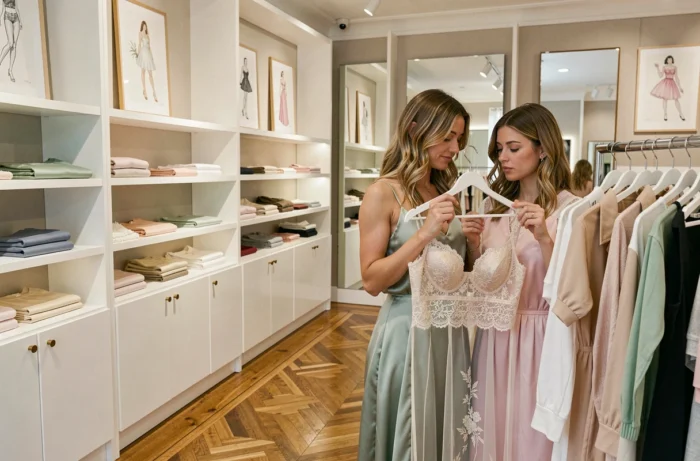
The carbon score (or “CO2 score”), currently being rolled out in France, will add an additional layer of information. The available data does not yet allow for measuring the concrete impact of this labeling on purchasing decisions in lingerie, but the direction is clear: transparency will become a selection criterion on par with style or comfort.
Selection criteria for French lingerie suited to one’s morphology
Beyond trends, the choice of a lingerie piece relies on often underestimated technical criteria. Morphology, breast type, and daily use determine the relevant model far more than brand or price.
- For small busts (A and B cups), triangles and bralettes without padding offer a natural shape. Push-up models remain an option, but prolonged use can lead to discomfort over time.
- For medium to large busts (C to E cups), a full-coverage underwired bra remains the reference for support. Wire-free versions exist but require careful fitting to check lateral support.
- For intensive daily use (full day at the office, travel), prioritize wide underband and adjustable straps with memory foam fabric.
Trying on remains the only reliable way to validate a model, regardless of the size guide displayed. Size discrepancies between French brands can reach half a size in the band and one cup size in depth.
French lingerie maintains a lead in textile expertise and aesthetics. The coming years will tell whether the sector can combine this requirement with new expectations for comfort, inclusivity, and environmental traceability. The movement is underway, and the responses are still in development.