The majority of French artisan shops close within the first three years of operation, primarily due to a lack of cash flow. This observation, documented in a report by INMA in 2025, reflects a structural paradox: French artisanal know-how has never been so culturally valued, yet its economic model remains fragile. Understanding French craftsmanship today means accepting this tension between technical excellence and commercial viability.
3D Printing and Augmented Reality in Art Workshops
The integration of digital tools in French artisan workshops has been the hallmark of recent years. 3D printing is used for rapid prototyping, particularly in jewelry, ceramics, and cabinetry. It allows for testing a shape, validating a proportion, or producing a complex mold without spending hours of manual labor on a piece that might be discarded.
Augmented reality finds its place in heritage restoration. An artisan can overlay a digital model onto a degraded architectural element to plan their intervention with millimeter precision. Artificial intelligence, on the other hand, comes into play upstream: assisting in pattern generation, optimizing cuts to reduce material waste.
We observe that these technologies do not replace the craft. A woodturner using 3D modeling to visualize their piece remains the one guiding the chisel on the lathe. Artisans who adopt these tools on lateliersingulier.fr precisely combine this dual skill: mastery of the craft and digital culture. Digital technology transforms design, not execution.
Art Professions in France: The Issue of Technical Transmission
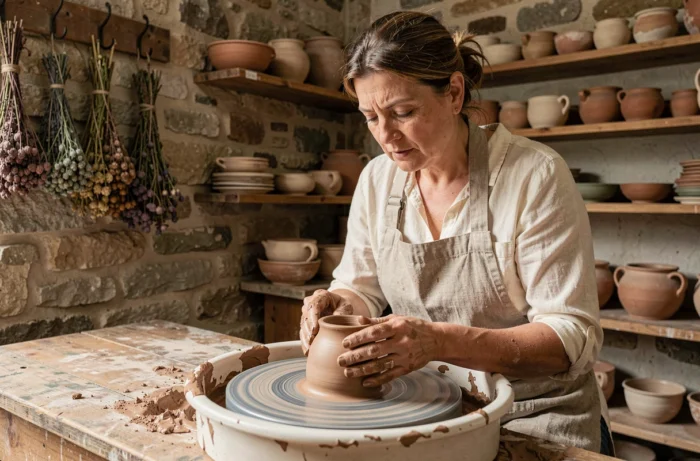
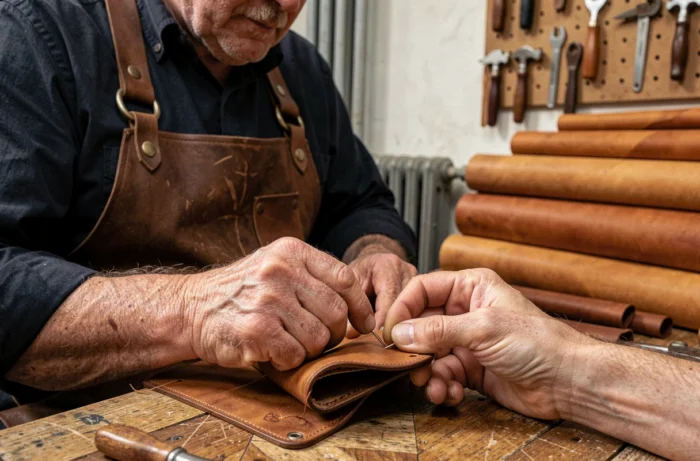
Transmission in art professions is not limited to demonstrating a gesture. It involves a transfer of tacit knowledge, those that are not written in any manual: the exact pressure of the thumb on clay before turning, the sound produced by a properly vitrified enamel, the tension of a chain thread at the right weight.
A new high school diploma, accessible directly after middle school, now opens the way to careers in cabinetry, watchmaking, or jewelry making. This shortened pathway addresses a concrete need: long training programs were losing candidates along the way, and workshops were lacking skilled labor.
Professional Retraining and Artisan Training
Profiles in retraining represent an increasing share of the training workforce. Organizations like MakeICI in Nantes offer specific carpentry programs for adults from other sectors. Retraining towards craftsmanship attracts technical profiles, often engineers or designers, who bring project culture and digital fluency useful in the workshop.
FAFCEA has modified its criteria for funding professional training for artisans, reshaping financing possibilities. We recommend that active artisans check their eligibility before committing to a supplementary course.
French Craftsmanship and Economic Model: Why Shops Close
According to a Bpifrance study from 2025, the majority of closures of artisan shops are related to cash flow issues, not a lack of customers or quality. The artisanal production cycle, inherently long, creates a gap between expenses (raw materials, rent, overhead) and income.
- The selling price of an artisanal piece must cover an unavoidable manufacturing time, often several days for a unique object, which makes the unit margin structurally low if the pricing strategy is too cautious.
- Online sales reduce fixed costs associated with a physical shop but require skills in product photography, logistics, and SEO that many artisans do not possess.
- Markets and fairs remain an effective sales channel, provided that those selected correspond to the price segment practiced.
An artisan who sets their prices below their actual hourly cost condemns their business. The calculation of the complete cost price, including design, prototyping, and finishing time, remains the weak point for many creators who undervalue their work.
Labels and Certifications: What the EPV Label Really Guarantees
The Entreprise du Patrimoine Vivant (EPV) label is awarded by the State to companies that possess rare, renowned, or ancestral know-how. It does not certify the origin of raw materials or the place of manufacture of each component. The EPV label attests to technical competence, not to total geographical origin.
This distinction matters. An EPV-labeled workshop in leather goods may use tanned leathers sourced abroad while performing assembly and finishing in France. The Origine France Garantie label, on the other hand, requires that the product derives its main characteristics from French manufacturing. The two labels do not cover the same scope.
Artisan of Art and Production Artisan: Two Statuses, Two Realities
The list of 198 art professions cataloged by the National Institute of Art Professions covers a wide spectrum, from luthiers to plasterers. An artisan of art creates unique pieces or very small series. A production artisan manufactures in limited but repeated series. Both can possess exceptional know-how, but their economic constraints differ radically.
The artisan of art lives off sporadic, often irregular orders. Their order book fluctuates with decoration, restoration, or private commission projects. The production artisan can smooth out their cash flow through regular restocks, provided they have structured a reliable distribution.
The law simplifying economic life, currently being implemented, should lighten some administrative procedures for small artisan structures. Simplifying administration frees up time for workshop work, a lever often underestimated in support policies for the sector.