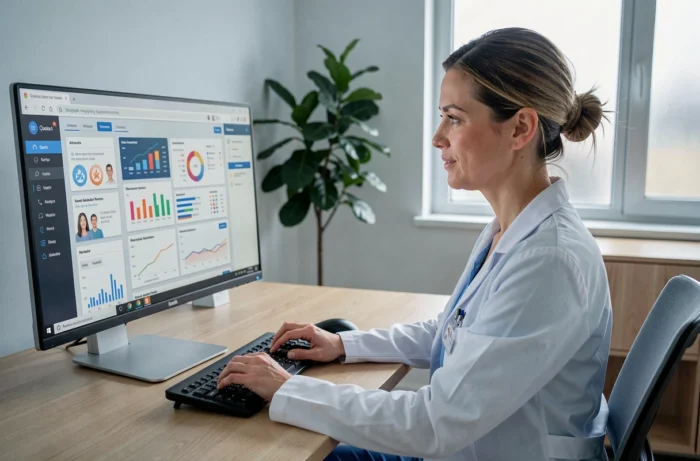
E-health in France relies on a stack of platforms, frameworks, and digital services, the mapping of which remains difficult to read for both professionals and users. Between the foundational services supported by the Digital Health Agency, the regional resources of the ARS, and public tools like My Health Space, the landscape is structured around complementary but scattered components. Measuring their coverage, adoption, and interconnection allows us to understand the actual state of the digital transformation of the healthcare system.
Interoperability and Security Frameworks: The Technical Foundation of E-Health
The least known e-health resources to the general public are also the most structuring. The Interoperability Framework for Health Information Systems (CI-SIS), the PGSSI-S security framework, and the COMENS ethical framework constitute the common heritage on which all digital health services must rely.
The 2026-2028 objectives contract of the ANS published in July 2026 mandates their coordinated update. The agency must now co-develop the evolution of these frameworks and include them in a roadmap validated by regulatory bodies (GOREG). The stated goal: to improve readability and ownership by all stakeholders in digital health.
To navigate all these resources, the Tsa E-Santé pages compile a thematic index that facilitates access to the various documentary components of the sector.
This technical layer conditions everything else. Without interoperability, a patient’s data remains siloed between their primary care physician, the hospital, and the pharmacy. Without a common security framework, each publisher applies its own rules, which undermines user trust.

National E-Health Platforms: Comparative Scope and Uses
Several platforms coexist at the national level, each with a specific scope. Their complementarity is not always evident to healthcare professionals or the public.
| Platform | Provider | Target Audience | Main Function |
|---|---|---|---|
| My Health Space | Health Insurance / ANS | Users (patients) | Digital health record, storage of medical documents |
| esante.gouv.fr | ANS | Professionals, publishers | Frameworks, foundational services, regulatory news |
| Health.fr | Ministry of Health | General public | Health information, directory of care locations, prevention |
| ROR Directory | ANS / ARS | Professionals, regulators | Description of health offerings across the national territory |
| SantéBD | CoActis Santé Association | Patients, caregivers, healthcare providers | Educational sheets in easy-to-read language |
My Health Space positions itself as the digital health record for the patient’s entire life. In contrast, esante.gouv.fr targets technical and institutional actors who build or integrate digital solutions. Health.fr plays a role as a public information portal focused on prevention and directing users to care locations.
The ROR, on the other hand, operates in the background. It catalogs the operational activities of healthcare and social care establishments, the available skills, and, during crises, the available intensive care or resuscitation beds. Its value is primarily measured in situations of hospital strain.
Regional E-Health Strategies: The Gap Between National Roadmap and Local Deployment
The national roadmap 2023-2027 sets the course. The ARS translates it into regional strategies that reveal heterogeneous levels of advancement.
The ARS Bourgogne-Franche-Comté, in its e-health strategy updated in August 2026, organizes four orientations, including one to facilitate the sharing and access to health information. This orientation explicitly targets the increase in the use of My Health Space, telemedicine, and tele-expertise.
Other regions like PACA launch specific project calls for the digital ESMS program, aimed at healthcare and social service establishments. These calls condition the funding of digital tools on the adoption of national frameworks.
- Awareness resources (videos, animation tools, prevention posters) are produced at the regional level and differ from one ARS to another, complicating their mutualization.
- Independent healthcare professionals access foundational services via the e-CPS application, which serves as a mobile identification key to connect to health information systems.
- Healthcare and social service establishments must describe and update their offerings in the ROR, but the workload is alleviated by automated imports from existing databases.
Transition of Digital Skills in Teams
The adoption of e-health tools does not solely depend on technology. Since 2026, OPCO Santé has offered a digital skills transition pathway aimed at supporting healthcare teams towards autonomy with these tools. This type of training resource remains under-documented in traditional institutional pages, even though it directly conditions the usage rate of the platforms.
Evaluation of Digital Health Solutions: The HAS Framework
The High Authority of Health has published specific recommendations for the evaluation of digital health solutions. This framework distinguishes digital medical devices (monitoring applications, diagnostic aid tools) from simple information or prevention tools.
For actors developing or funding digital tools, these HAS recommendations define the scientific evaluation criteria: clinical evidence, data security, ergonomics, accessibility. They apply equally to applications intended for the public and to professional software integrated into care pathways.
The articulation between the ANS frameworks (interoperability, security) and the HAS framework (clinical evaluation) creates a dual filter. A digital health tool compliant with the ANS technical standards may fail the HAS evaluation if it does not demonstrate measurable clinical benefit. Conversely, a clinically relevant application that is not interoperable cannot be integrated into the national ecosystem.
This cross-requirement explains why the mapping of e-health resources is not just a list of sites. Each component, from the technical framework to the educational sheet in easy-to-read language, meets a specific need in a chain that goes from the design of a tool to its daily use by a patient or caregiver. The challenge remains to make this architecture readable for those who, at the end of the chain, simply need to access their medical file or find a care location.