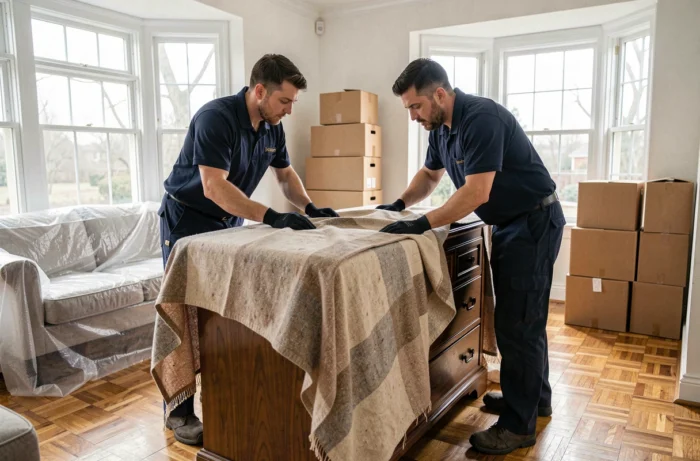
The moving market in France relies on thousands of companies with very different profiles, from local family-run businesses to national franchised networks. Comparing movers before signing a quote remains the most reliable approach to avoid unpleasant surprises, but the usual comparison criteria (price, online reviews, availability) are not always sufficient to differentiate the offers.
Subcontracting and the chain of responsibility: the blind spot of moving quotes
A signed quote with company A does not guarantee that the team present on the day will be from that company. The use of subcontracting alters the chain of responsibility in case of damage or disputes. Some companies reserve the contract and then delegate execution to external teams, sometimes hired for the occasion.
This practice is not illegal, but it complicates recourse. If an item is damaged, the contractual contact remains the signer of the quote, but managing the claim can get bogged down between two distinct entities. Before validating an offer, asking directly: “Is the team that will intervene employed by your company?” helps clarify this point.
To consult a comparison and reviews of movers that take these operational criteria into account, cross-referencing multiple sources remains more reliable than relying on a single ranking.

Value declaration and compensation caps: what moving insurance really covers
Most comparisons focus on the price of the quote and customer reviews. Insurance often appears only in fine print. Yet, it is the item that determines what you will recover in case of damage.
The value declaration conditions the amount of compensation. This document, filled out before the move, lists the transported goods and their estimated value. Without a value declaration, compensation is limited to a flat cap, often well below the actual value of furniture or fragile items.
- Check that the quote explicitly mentions the included insurance and its caps per item and per claim.
- Fill out the value declaration carefully, distinguishing valuable items (electronics, artworks, instruments) from ordinary furniture.
- Ask if an insurance extension is possible for items whose value exceeds the standard cap.
A professional mover who does not offer a value declaration, or who sidesteps the insurance question during the quote, sends a clear warning signal.
Remote or on-site technical visit: impact on the reliability of the mover’s quote
The prior technical visit remains the most reliable way to estimate the volume to be transported, access constraints (floors, parking, lift) and packaging needs. The remote visit via videoconference has established itself as a credible alternative, with a video inventory conducted by the client under the guidance of the sales representative.
Both formats have their limitations. The on-site visit allows the professional to identify invisible constraints on video: the exact width of a staircase, the condition of the floor covering, the distance between the truck and the front door. The remote visit, on the other hand, is better suited for small volumes or standard moves without access difficulties.
When the on-site visit changes the quote
For large volume housing or complex access (narrow street, no elevator, high floor), a significant discrepancy may appear between a remote quote and a quote after an on-site visit. Accepting a quote based solely on a phone estimate exposes you to the risk of additional costs on moving day when the team discovers unanticipated constraints.
Systematically requesting a visit (physical or detailed video) before comparing offers allows for comparable quotes based on the same scope of services.
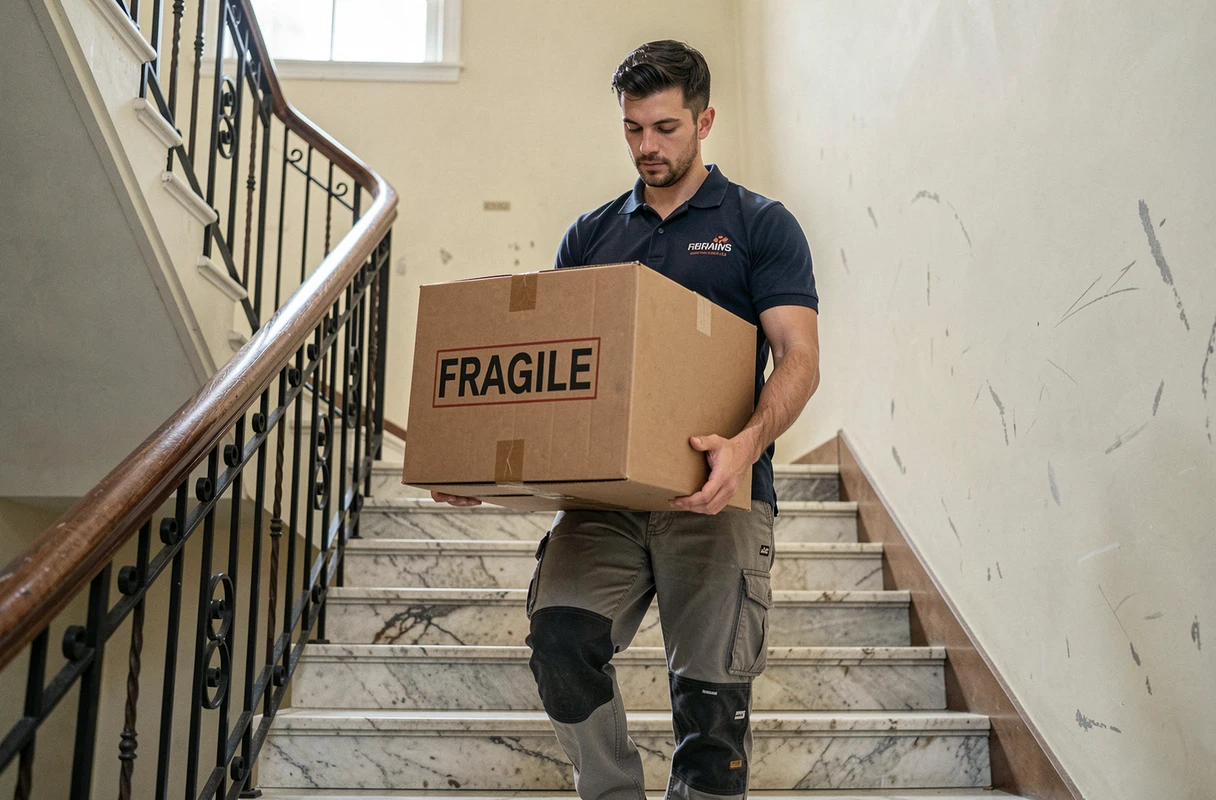
Low emission zones and city center access: a concrete selection criterion for the mover
Low emission zones (LEZ) established in several French metropolitan areas add a logistical constraint rarely mentioned in standard comparisons. A truck that does not comply with LEZ restrictions will not be able to legally access the loading or delivery site.
In Lyon, for example, some moving companies highlight the compliance of their fleet with the required Crit’Air stickers. For a move involving a city center subject to these restrictions, checking this point avoids an unpleasant surprise on loading day: date postponement, emergency vehicle change, or distant parking with additional carrying.
Questions to ask about urban logistics
- Does the planned vehicle have the necessary Crit’Air sticker for the loading and delivery area?
- Does the company handle parking permits with the town hall, or is it up to the client to take care of it?
- In case of temporary restrictions (construction, market, event), is a logistical backup plan provided in the contract?
These questions, asked as soon as the quote request is made, help distinguish companies that master urban logistics from those that discover it on the day of the move.
Choosing a mover is not just about picking the cheapest quote or the highest-rated company online. The criteria that truly protect are contractual: detailed insurance, value declaration, prior technical visit, vehicle compliance. A transparent quote on these points reflects a level of professionalism that customer reviews alone do not always measure.