
Family bonds are rarely built during big events. They are woven through repeated gestures, shared habits, and the micro-moments of daily life. Strengthening family harmony takes less time than one might think, provided you choose concrete practices that fit your pace.
Here are ten actionable ideas, tested in various family contexts, to nurture the bond between parents and children over the days.
1. Establish one screen-free meal per day

Several recent European studies show that simply glancing at a phone during a conversation is enough to reduce the feeling of emotional connection in children. Some teenagers describe a sense of insignificance when their parents prioritize their smartphones over face-to-face exchanges.
One meal a day where all phones remain out of the room changes the dynamic. Conversations start more easily, and children get into the habit of sharing their day without visual competition. One screen-free meal a day is enough to restore mutual attention.
To make the habit stick, it may be helpful to explore the family section of Buzz Stream to find complementary activities that extend this time of exchange.
2. Practice parent-child role reversal

For half an hour, children become the parents. They decide on the menu, give instructions, and organize the rest of the evening. The adults, in turn, behave like children (spilling a glass, asking for the blue cup instead of the red one).
This game provokes laughter, but it also serves a deeper purpose. The child experiences responsibility, and the parent rediscovers how certain instructions can seem arbitrary from a lower perspective. Role reversal develops mutual empathy without any moralizing discourse.
3. Slip a love note into the breakfast bowl

A drawing, three lines, a personal joke. The gesture takes less than a minute the night before. The child discovers it in the morning, often before fully waking up.
This ritual works because it is tangible. Unlike a message on a phone, paper can be kept, reread, and slipped into a notebook. Some families build up a small box of notes over the months that they read together at the end of the year.
4. Create a family photo album day

Have you ever noticed that children love to see their parents as kids? Pulling out old albums, sharing childhood mischief, showing birth photos creates a bridge between generations.
Sharing your childhood with your children strengthens the sense of family belonging. The child understands that they are part of a larger story. The parents’ embarrassing anecdotes make the relationship more horizontal, more intimate.
5. Describe efforts instead of judging results

The phrase “I love watching you do that” is a much better substitute for “that’s good” or “well done.” Describing what you observe (“you tried three times without getting discouraged”) nurtures intrinsic motivation in the child, where rewards create a dependence on external validation.
This change in posture requires no materials, no extra time. It applies to drawing, homework, tidying up, and sports. The parent learns to observe before commenting, which also improves the quality of their attention.
6. Plan exclusive father-child time each week

Available data shows that exclusive time spent between father and child remains very limited and stagnant, even when overall family time increases. This imbalance often goes unnoticed.
Blocking off a weekly slot, even a short one, where the father is alone with each child in turn changes the relationship. The activity doesn’t matter much (walking, cooking, DIY). It’s the exclusivity of the moment that counts, not its duration.
7. Use screens as a bonding tool, not as a substitute

The screen has become a central infrastructure of social connection. It allows maintaining closeness with distant grandparents, sharing a documentary together, and playing cooperatively.
The problem is not the screen itself, but the solitary and unchosen use. Watching a movie together, followed by a discussion, strengthens bonds. A child alone in front of a tablet while their parents scroll separately weakens them. The distinction hinges on a simple criterion:
- The screen is shared and discussed: it becomes a conversation tool
- The screen isolates each member in their bubble: it fragments family attention
- The screen connects with distant family: it extends the bond beyond the home
8. Adopt a gratitude ritual before bedtime

Every evening, everyone mentions a pleasant moment from their day. No need for solemnity. The exercise takes two minutes, sitting on the bed or in the hallway.
Naming a positive moment each evening trains the brain to spot the good in difficult days. Children gradually learn to identify their positive emotions, contributing to long-term emotional regulation.
9. Collectively disconnect from work and school stress
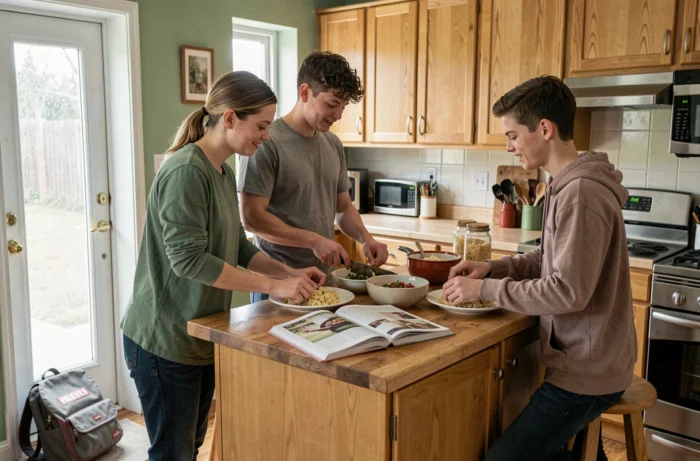
What happens at the office or in class stays there. Defining a clear boundary between pressured times and family times protects the home from a constant contamination by stress.
Concretely, this can take the form of a shared signal:
- A code word that any member says when the conversation drifts toward work or school worries
- A place in the house declared a “no homework or emails zone”
- A specific time after which backpacks and work computers are put away
10. Organize a cooperative rather than competitive activity
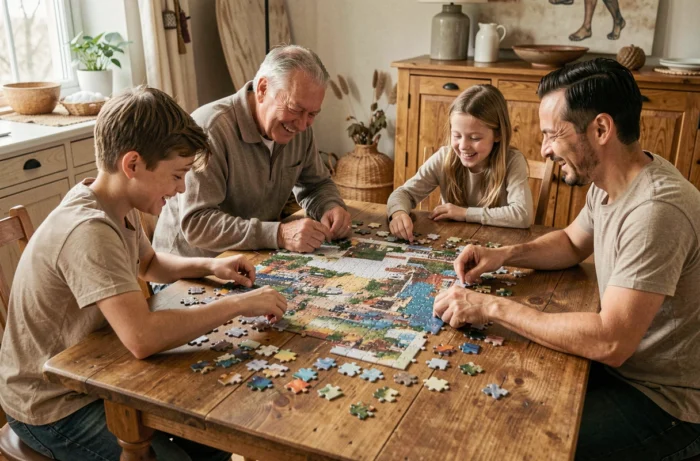
Cooking a meal together, assembling furniture, planting a garden. Activities where everyone contributes to a common result strengthen cohesion much more than competitive games, which sometimes generate frustration and conflicts among younger ones.
The choice of activity depends on the children’s ages. A four-year-old can wash vegetables. A teenager can manage the entire recipe. The goal is not the perfection of the result, but the fact of having created something together.
Family harmony is not decreed during an annual family meeting. It is cultivated in daily micro-rituals, adapted to the rhythm of each household. Among these ten practices, two or three are enough to sustainably change the quality of exchanges between parents and children.